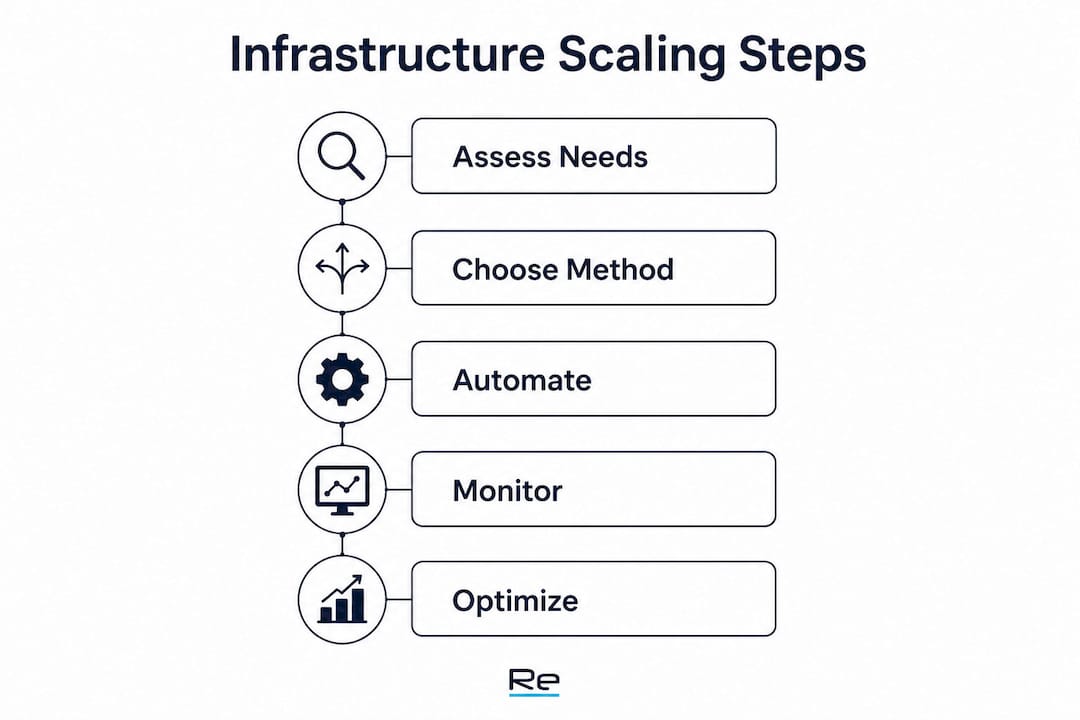
Scaling IT infrastructure is the systematic process of expanding and adapting your IT resources incrementally to meet growing demand, without compromising performance, security, or cost control. Done well, it follows a clear sequence: assess current capacity, identify load patterns, select the appropriate scaling method, automate where possible, and monitor continuously. The Microsoft Azure Well-Architected Framework formalises this as a reliability recommendation, stating that scaling strategies should be based on actual or predicted usage patterns and should minimise manual intervention. Infrastructure scaling typically progresses through recognisable stages:
- Baseline assessment of current workloads and capacity limits
- Identification of load patterns (static, dynamic predictable, or dynamic unpredictable)
- Selection of scaling method: vertical, horizontal, step, or automated
- Implementation of automation and infrastructure-as-code practices
- Deployment of monitoring and alerting to guide scaling decisions
- Ongoing review and adjustment as demand evolves
Getting this sequence right reduces cost, improves resilience, and prevents the reactive firefighting that plagues teams who scale without a plan.
How do you assess your infrastructure scalability needs in the UK?
Understanding what your infrastructure actually needs to support is the starting point for any scaling exercise. UK organisations face a specific set of pressures: data residency obligations under UK GDPR, network resilience requirements driven by distributed sites, and cost control priorities that make over-provisioning particularly expensive. These factors shape not just what you scale, but how and when.
A structured assessment covers several dimensions. Workload analysis tells you where current bottlenecks sit, whether in compute, storage, or network throughput. Growth forecasting, based on business plans and historical usage data, tells you how much headroom to build in. Compliance considerations, particularly for sectors such as education, manufacturing, and financial services, determine which architectural choices are permissible.
Checklist for assessing scaling requirements:
- Map current resource utilisation across compute, storage, and network
- Identify peak load periods and their frequency
- Document growth projections for the foreseeable future
- Review UK regulatory requirements relevant to your sector
- Assess geographic distribution of users and services
- Evaluate existing automation capabilities and tooling gaps
- Confirm budget constraints and total cost of ownership targets
Load patterns matter enormously here. A predictable Monday-morning spike from staff logging into an ERP system calls for a different response than an unpredictable surge driven by a product launch or a public-sector announcement. The Azure Well-Architected Framework scaling guidelines distinguish between static, dynamic predictable, and dynamic unpredictable workloads precisely because each demands a different scaling strategy.
- Predictable loads suit scheduled, pre-emptive scaling
- Unpredictable loads require automated, trigger-based responses
- Static loads may need no scaling at all, just right-sizing
Understanding IT infrastructure challenges in your specific environment is the prerequisite before any scaling decision is made.
What are the main types of infrastructure scaling and how do they differ?
The three core scaling methods each address different constraints, and choosing the wrong one for a given workload wastes both money and engineering time.
Vertical scaling adds capacity to an existing resource, upgrading a server’s CPU, RAM, or storage. It is straightforward to implement and requires no application changes, but it has a hard ceiling and typically causes downtime during the upgrade. It suits workloads that cannot be distributed, such as legacy monolithic databases.

Horizontal scaling adds more instances of a resource, placing additional servers or containers behind a load balancer. The Azure Well-Architected Framework is explicit that systems must be designed to be horizontally scalable, with services built stateless so that requests can be routed to any available instance. A UK retailer running a Cisco-backed network, for example, might add web server nodes ahead of a seasonal peak rather than upgrading a single machine.
Step scaling sits between manual and fully automated approaches. It adjusts resources in predefined increments when a metric crosses a threshold, such as adding two compute nodes when CPU utilisation exceeds 70% for five consecutive minutes. This gives engineering teams predictable, controlled growth without requiring constant manual intervention.
Automated scaling takes step scaling further by continuously evaluating metrics and adjusting capacity without human input. Meaningful load metrics for triggering autoscaling include CPU and memory utilisation, but also queue depth, HTTP queue length, and custom application metrics. Using a combination of simple and advanced metrics produces more reliable scaling decisions than relying on CPU alone.
Key considerations for each method:
- Vertical scaling: fast to implement, limited ceiling, potential downtime
- Horizontal scaling: high resilience, requires stateless design, more complex networking
- Step scaling: predictable increments, good for known load patterns, needs threshold tuning
- Automated scaling: lowest manual overhead, requires mature monitoring, risk of flapping if thresholds are poorly configured
Best practices for scaling distributed IT infrastructure
Automation is the single most important factor in scaling distributed infrastructure reliably. Manual scaling processes do not scale effectively beyond small server counts; at enterprise scale, they produce configuration drift, delayed responses, and compounding errors. The answer is infrastructure-as-code, where every environment is defined, version-controlled, and deployed consistently.
Designing stateless services is equally critical. When application components hold session state locally, horizontal scaling becomes unreliable because requests must return to the same instance. Externalising session state to a dedicated store, such as Redis or a managed cache service, removes that constraint and allows any node to handle any request.

Database performance is often the first constraint to emerge during a scaling exercise, and it tends to appear before compute limits are reached. Read/write imbalances cause contention; the standard remedies are read replicas to offload query traffic and connection pooling to reduce the overhead of establishing new database connections. Scaling compute without addressing database architecture simply moves the bottleneck rather than removing it, as the Azure Well-Architected Framework notes when recommending component-level scaling.
Pro Tip: Version-control your infrastructure definitions from day one. Configuration drift, where live environments diverge from their documented state, is harder to reverse than it is to prevent. Teams that adopt infrastructure-as-code early spend far less time troubleshooting unexplained failures during scaling events.
Actionable best practices for distributed scaling:
- Design all services to be stateless where architecturally feasible
- Apply infrastructure-as-code to every environment, including staging and test
- Scale at the component level, not just at the compute tier
- Use meaningful, multi-metric triggers for autoscaling decisions
- Build capacity buffers to absorb unexpected demand spikes
- Implement circuit breakers to prevent cascading failures during partial outages
- Test scaling procedures in non-production environments before applying to live systems
Common pitfalls and when not to scale your infrastructure
Over-scaling is as damaging as under-scaling. Adding capacity without a clear demand signal increases operational complexity, raises costs, and introduces new failure points. Effective scaling matches capacity to demand; scaling ahead of genuine need is an investment that rarely pays back.
The most frequent mistake is treating scaling as the first response to a performance problem. Before adding resources, teams should rule out application-level inefficiencies: poorly written queries, memory leaks, or misconfigured caching layers. These issues do not disappear when you scale; they become more expensive.
Pro Tip: If your monitoring shows high resource utilisation but response times are acceptable and error rates are low, you may not need to scale at all. Scaling decisions should be driven by user-facing metrics, not internal utilisation figures alone.
Ignoring load patterns is another common error. A team that scales reactively to a one-off traffic spike may leave that additional capacity running indefinitely, paying for resources that sit idle. Scheduled scale-down policies, tied to known quiet periods, recover that cost automatically.
Pitfalls to avoid:
- Scaling before investigating application-level inefficiencies
- Using CPU utilisation as the sole scaling trigger
- Failing to implement scale-down policies alongside scale-out rules
- Scaling without a rollback plan if the new configuration causes instability
- Neglecting to test autoscaling rules under realistic load conditions
- Scaling compute without addressing database or network bottlenecks first
- Applying manual scaling processes at enterprise scale, where they produce errors and delays
Scaling is also inadvisable when the underlying architecture has fundamental design flaws, such as singleton components that cannot be distributed, or when compliance requirements restrict where workloads can run. In those cases, architectural remediation must precede capacity expansion.
Re-solution’s step-by-step approach to infrastructure scaling in the UK
Re-solution has supported UK organisations across education, manufacturing, and logistics in scaling their Cisco-backed infrastructure for over 35 years. The approach is sequential, compliance-aware, and grounded in the realities of UK network and regulatory environments.
The scaling framework Re-solution applies follows these steps:
- Infrastructure audit: Establish a verified baseline of current assets, configurations, and performance metrics using Re-solution’s network audit service.
- Workload classification: Categorise workloads by load pattern (static, predictable, unpredictable) and compliance sensitivity.
- Architecture review: Identify singletons, stateful dependencies, and database bottlenecks that would constrain horizontal scaling.
- Scaling method selection: Match each workload to the appropriate method: vertical for legacy systems, horizontal for distributed services, automated for variable-demand applications.
- Automation implementation: Deploy infrastructure-as-code tooling and configure autoscaling policies with multi-metric triggers and flapping prevention.
- Compliance integration: Align scaling architecture with UK GDPR data residency requirements and sector-specific obligations, particularly for education and public sector clients.
- Monitoring and alerting: Instrument all tiers with meaningful metrics and configure alerts that distinguish genuine scaling signals from transient noise.
- Rollback planning: Define and test rollback procedures before any scaling change goes live, so that instability can be reversed quickly.
- Ongoing review: Schedule quarterly capacity reviews tied to business growth forecasts, adjusting scaling policies as demand patterns evolve.
Pro Tip: Treat your first scaling exercise as a template. Document every decision, threshold, and automation rule so that subsequent scaling events can be executed faster and with less risk.
UK-specific considerations that Re-solution builds into every engagement include network resilience planning for distributed sites, alignment with the National Cyber Security Centre’s guidance on secure infrastructure, and cost modelling that accounts for UK data centre pricing and energy costs. For organisations planning network infrastructure expansion, starting with a structured audit removes the guesswork from capacity planning.
Key steps and considerations:
- Begin with an audit, not an assumption
- Classify workloads before selecting a scaling method
- Address architectural constraints before adding capacity
- Automate scaling policies and version-control all configurations
- Integrate compliance requirements from the design stage
- Monitor user-facing metrics, not just infrastructure utilisation
- Plan rollback procedures as rigorously as the scaling changes themselves
For organisations ready to move from planning to execution, Re-solution’s managed network infrastructure services provide the expertise and tooling to scale confidently within UK compliance and operational constraints.

Key takeaways
Effective infrastructure scaling requires a sequential, workload-aware approach that combines the right scaling method with automation, monitoring, and a clear rollback strategy.
| Point | Details |
|---|---|
| Start with an audit | Baseline your current capacity and workload patterns before selecting any scaling method. |
| Match method to workload | Use vertical scaling for legacy systems, horizontal for distributed services, and automated for variable demand. |
| Automate to avoid drift | Manual scaling processes fail at enterprise scale; infrastructure-as-code prevents configuration drift and errors. |
| Scale at component level | Scaling compute without addressing database bottlenecks moves the constraint rather than removing it. |
| Plan rollback from the start | Define and test rollback procedures before any scaling change goes live to limit instability risk. |
Recommended
- Why invest in IT infrastructure: a 2026 guide
- Types of IT infrastructure: a 2026 guide for IT teams
- Plan network upgrades: step-by-step logistics for success
- Challenges in IT Infrastructure & How to Overcome | Re-Solution