TL;DR:
- UK schools hold sensitive personal, biometric, and behavioral data and must comply with UK GDPR and the Data Protection Act 2018. They are legally required to appoint a DPO, conduct DPIAs, maintain a ROPA, and ensure transparency and security in data handling. Proper governance, technical controls, and ethical considerations are essential to protect student trust and meet legal obligations.
UK schools and colleges hold some of the most sensitive personal data of any sector: pupil records, biometric identifiers, behavioural logs, special educational needs information, and staff personnel files. Under UK GDPR and the Data Protection Act 2018, educational institutions are legally bound to protect that data, demonstrate compliance, and respond effectively when things go wrong. Understanding educational data privacy is not optional for IT leaders; it is a statutory obligation with real consequences for failing to meet it.
The types of data schools process span three broad categories:
- Personal data: names, addresses, dates of birth, contact details, attendance records
- Special category data: health information, ethnicity, biometric data, special educational needs
- Behavioural and inferred data: monitoring logs, learning analytics, profiling outputs from EdTech platforms
Each category carries different legal thresholds and risk profiles. Getting the classification wrong at the point of collection is one of the most common compliance failures in UK schools.
Table of Contents
- What do UK data protection laws require from educational institutions?
- How should schools manage data privacy in practice?
- Why data privacy in schools is an ethical issue, not just a legal one
- Recommendations for UK educational IT leaders
- Key takeaways
- Re-solution helps UK schools meet their data protection obligations
What do UK data protection laws require from educational institutions?
The primary legal frameworks are UK GDPR and the Data Protection Act 2018. Together, they require schools to comply and demonstrate compliance, not merely to have policies on paper.
Three specific obligations stand out for IT administrators:
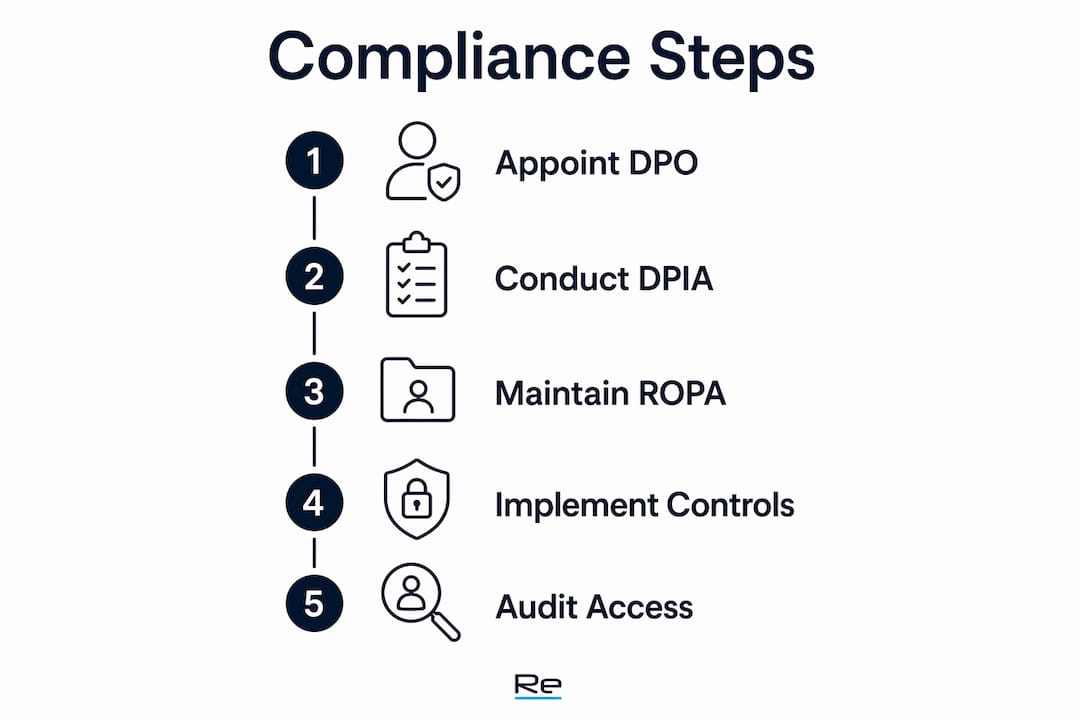
Data Protection Officer (DPO). Schools must appoint a DPO, either in-house or via a contracted service. The DPO reviews privacy notices, advises on lawful processing grounds, and acts as the primary contact for the Information Commissioner’s Office (ICO).
Data Protection Impact Assessments (DPIA). A DPIA is legally required whenever processing is likely to result in a high risk to individuals’ rights and freedoms. Biometric systems, AI-driven learning tools, and new monitoring software all trigger this threshold. The DPIA must be documented before deployment, not retrospectively.
Record of Processing Activities (ROPA). Maintaining a ROPA is a legal obligation for UK schools. It captures what data is processed, on what lawful basis, with whom it is shared, and for how long it is retained. A well-maintained ROPA also feeds directly into privacy notice drafting and breach response.
Privacy notices themselves must be clear, accessible, and regularly updated, covering why data is collected, how it is used, retention periods, and sharing arrangements. The ICO expects notices to be reviewed at least annually and whenever processing changes materially.
Legal compliance checklist for UK schools:
- Appoint a qualified DPO and document their remit
- Establish and maintain a current ROPA
- Define lawful grounds for every processing activity
- Publish accessible privacy notices for pupils, parents, and staff
- Conduct DPIAs before introducing high-risk processing
- Implement a documented data breach response procedure
- Train all staff with access to personal data
How should schools manage data privacy in practice?
The principle of data minimisation is the most consistently under-applied control in educational IT. Schools frequently collect more data than they need, retain it longer than necessary, and grant access more broadly than the processing purpose justifies.

Technical controls form the first line of defence. Encryption at rest and in transit, role-based access control, and network segmentation all reduce the blast radius of a breach. The principle of least privilege, granting staff access only to the data their role requires, is particularly effective. Most school data breaches originate not from external attackers but from insider threats or misconfigured cloud storage, making internal access governance a higher priority than perimeter defence alone.
Pro Tip: Audit staff access rights at least once per term. Leavers, role changes, and temporary contractors are the most common sources of excessive permissions that persist unnoticed for months.
Schools are data controllers under UK GDPR even when using third-party EdTech platforms. That means due diligence and a DPIA are required before onboarding any new vendor, regardless of how the supplier markets its own compliance credentials. Reviewing a vendor’s data processing agreement, sub-processor list, and data residency arrangements is not optional; it is part of the school’s own accountability obligation. For practical guidance on cloud security in schools, the technical controls required extend well beyond the vendor’s default settings.
Subject Access Requests (SARs) create a recurring operational burden that many schools underestimate. Schools must redact third-party data before disclosure, which requires either manual review or technical tooling. Neither is free, and neither is quick. Building SAR handling into IT resource planning, rather than treating it as an ad hoc task, prevents the compliance failures that arise when requests arrive during busy periods.
Operational best practices:
- Apply data minimisation at the point of collection, not retrospectively
- Encrypt all devices storing personal data, including staff laptops and USB drives
- Enforce least privilege access and review permissions each term
- Conduct DPIAs before deploying new EdTech, AI tools, or monitoring systems
- Vet all third-party vendors with a formal data processing agreement review
- Maintain a documented incident response plan with defined escalation paths
- Allocate dedicated IT resource for SAR handling and redaction
For schools reviewing their data privacy best practices, the technical and administrative controls above work together; neither alone is sufficient.
Why data privacy in schools is an ethical issue, not just a legal one
Legal compliance sets the floor, not the ceiling. The Council of Europe’s guidelines under Convention 108+ require schools to apply strict necessity and proportionality tests to all data collection, recognising that data privacy is an enabling right interconnected with children’s rights to non-discrimination, freedom of expression, and protection from economic exploitation.
The datafication of education raises concerns that go beyond regulatory risk. When personal data collected for learning purposes is used for profiling or commercial ends, it erodes the trust relationship between schools and the communities they serve. Children in particular cannot meaningfully consent to data practices embedded in platforms they are required to use; the choice is often between using the tool or receiving no instruction at all.
Excessive monitoring via educational software can cause student alienation and a sense of powerlessness, with measurable effects on trust and learning experience. Schools deploying filtering and monitoring systems should disclose clearly in their privacy notices what is monitored, why, who can access the data, and how long it is retained. Transparency here is not just good practice; it is a statutory requirement under UK GDPR.
UNESCO’s guidance on protecting learners’ privacy calls on educational institutions to take the lead in safeguarding data, arguing that a balance must be struck between the transformative potential of digital technology and the protection of individual rights. That balance requires active governance, not passive compliance.
Key ethical concerns for IT decision-makers:
- Biometric data should not be collected routinely; each use case requires a DPIA and a less-intrusive alternative assessment
- Commercial use of pupil data by EdTech vendors must be explicitly prohibited in data processing agreements
- Monitoring systems must be proportionate to the safeguarding aim and disclosed transparently
- Pupils and parents must have genuine, accessible means to exercise their data rights
- Privacy by design should be applied when selecting or configuring any new platform
Recommendations for UK educational IT leaders
Effective student data security rests on three pillars: legal accountability, technical controls, and ethical governance. Schools that treat these as separate workstreams tend to develop gaps between policy and practice.
Immediate priorities:
- Confirm your DPO appointment is documented and their role is actively resourced
- Review and update your ROPA to reflect current processing activities
- Schedule DPIAs for any AI tools, biometric systems, or new monitoring platforms in use or under evaluation
- Audit staff access rights and enforce least privilege across all systems
- Review all third-party EdTech vendor agreements for data processing compliance
- Update privacy notices to reflect current processing and ensure they are accessible to pupils, parents, and staff
- Test your incident response plan before a breach occurs, not after
Schools that have not yet mapped their data flows against their ROPA will find that exercise alone surfaces compliance gaps. It is the most practical starting point for any institution building or rebuilding its data governance programme.
Key takeaways
UK schools must treat data privacy as a legal, technical, and ethical obligation simultaneously, with UK GDPR and the Data Protection Act 2018 setting the statutory baseline for all processing decisions.
| Point | Details |
|---|---|
| Legal framework | UK GDPR and the Data Protection Act 2018 require DPO appointment, ROPA maintenance, and DPIA completion for high-risk processing. |
| Insider threat priority | Most school data breaches originate from insider threats or misconfigured cloud storage, making least privilege access controls a critical control. |
| Vendor accountability | Schools remain data controllers when using third-party EdTech platforms and must conduct due diligence and DPIAs before onboarding any new vendor. |
| Ethical governance | Excessive monitoring can cause student alienation; Council of Europe guidelines require necessity and proportionality tests for all data collection. |
| Re-solution’s role | Re-solution provides Cisco-backed managed IT services, infrastructure audits, and security solutions tailored to help UK schools meet their compliance obligations. |
Re-solution helps UK schools meet their data protection obligations
UK schools face a specific challenge: compliance obligations that are technically demanding, legally binding, and resource-intensive, all within budgets that rarely stretch to a dedicated security team. Re-solution gives educational institutions direct access to over 35 years of Cisco IT infrastructure expertise, without the overhead of building that capability in-house.
Re-solution’s managed IT services for education cover the technical controls that underpin data privacy compliance: network segmentation, access control, encryption, and monitoring configurations aligned with UK GDPR requirements. Infrastructure audits identify where current systems fall short of the IT infrastructure standards schools need to meet. Network as a Service (NaaS) gives schools a governed, compliant network foundation without capital expenditure. For institutions evaluating their current posture, Re-solution’s audit and survey services map existing data flows, access rights, and vendor arrangements against compliance requirements.
Get in touch with Re-solution to arrange a consultation and find out where your school’s data privacy infrastructure stands today.
Recommended
- Data privacy best practices for education and manufacturing
- Data privacy in IT: A clear guide for managers and leaders
- Data Privacy Challenges to Watch in 2025 | Re-Solution