
TL;DR:
- A Cisco-led cloud-managed network as a managed service offers UK hospitality organizations reliable, scalable, and secure connectivity solutions.
- Implementing a staged deployment with surveys, pilots, and centralized security policies minimizes risks and manages costs effectively.
For UK hospitality IT leaders, a Cisco-led cloud-managed network delivered as a managed service (NaaS) is the fastest, most secure route to reliable, scalable connectivity across your estate.
The recommended approach: Deploy Cisco Meraki or Catalyst cloud-managed switching and wireless, connect sites via Cisco SD-WAN, enforce policy through Cisco DNA Center or a SASE framework, and operate the whole stack under a managed service contract with a Cisco-specialist partner. The immediate gains are predictable uptime, centralised security policy, and an OpEx funding model that removes large capital outlays. Start with a professional network survey and a four-to-six-week pilot before committing to a full roll-out.
Three benefits stand out from day one:
- Reliability: cloud-managed hardware with automated failover keeps guest Wi-Fi and payment systems online even when a local device fails.
- Centralised security: a single policy engine enforces segmentation across every site, reducing the risk of configuration drift.
- OpEx funding: a NaaS subscription replaces unpredictable capital expenditure with a fixed monthly cost, improving cashflow planning.
Table of Contents
- Why does cloud networking matter for UK hospitality?
- Which Cisco technologies map to hospitality requirements?
- How do you plan and deploy a hospitality network upgrade?
- What security and UK compliance requirements apply to hospitality networks?
- How do you choose the right managed network provider?
- Why Re-solution for UK hospitality networking?
- Key takeaways
- The part most IT leaders underestimate
- Talk to Re-solution about your hospitality network
- Useful sources and further reading
Why does cloud networking matter for UK hospitality?
Cloud networking in hospitality directly improves guest experience, staff productivity, and operational resilience. That is the core claim, and the evidence supports it across property types from boutique hotels to large pub estates.
Concrete benefits for hospitality operators:
- Centralised management of wired, wireless, and SD-WAN from a single dashboard, reducing the need for on-site IT staff at every venue.
- Faster site rollouts: cloud-provisioned templates push configurations to new locations without manual on-site programming.
- Consistent, high-quality guest Wi-Fi across all properties, supporting in-room entertainment, mobile check-in, and digital concierge services.
- Simplified IoT and IPTV support through dedicated VLANs and policy-based segmentation.
- Multi-site visibility: one pane of glass shows network health, client counts, and alerts across your entire estate.
Typical use cases in hospitality:
- Guest internet access — segregated SSIDs with bandwidth controls and captive portal authentication.
- POS and payment segregation — isolated VLANs for card payment terminals to meet PCI DSS requirements.
- Conferencing and events connectivity — temporary high-density wireless for conference rooms and event spaces, provisioned from the cloud in minutes.
- IoT and building systems — separate network segments for HVAC, access control, IPTV, and smart room devices, all managed centrally.
A unified technology ecosystem that connects network, PMS, and POS reduces integration gaps and long-term management overhead, which is why platform choice matters as much as hardware selection.
Which Cisco technologies map to hospitality requirements?
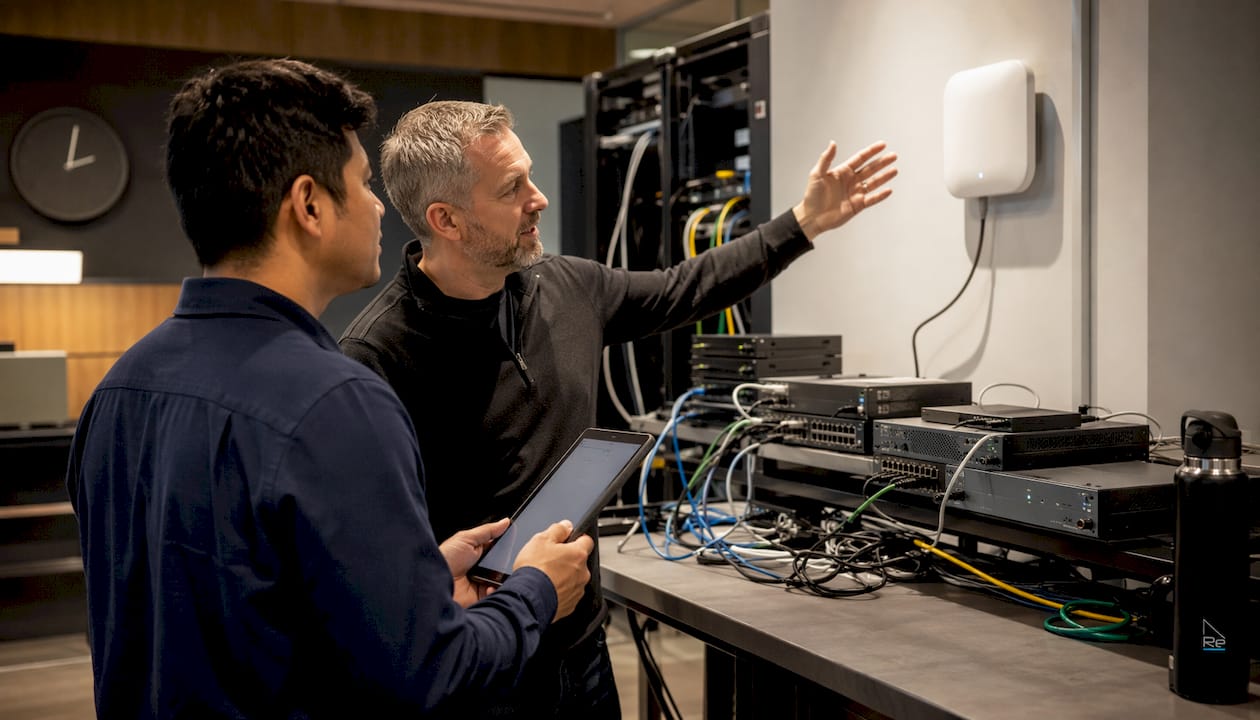
Deploy cloud-managed wireless and switching, edge SD-WAN, and centralised security as a stack. Each component addresses a specific hospitality need.
| Cisco technology | Hospitality requirement | Managed vs self-managed | Cost model | Security features | Scalability |
|---|---|---|---|---|---|
| Cisco Meraki (wireless + switching) | Guest Wi-Fi, IoT segmentation, multi-site visibility | Cloud-managed (dashboard) | OpEx / subscription | VLAN segmentation, MX firewall, content filtering | Add APs and switches via dashboard; scales to thousands of sites |
| Cisco Catalyst (switching) | Core and distribution switching, PoE for APs and IoT | Self-managed or cloud-managed via DNA Center | CapEx or NaaS | 802.1X NAC, MACsec, VLAN isolation | Modular chassis; suitable for large hotels and resorts |
| Cisco SD-WAN | Multi-site WAN connectivity, application-aware routing | Cloud-managed (vManage) | OpEx / subscription | Encrypted tunnels, application segmentation, Zero Trust WAN | Add sites without hardware changes at head office |
| Cisco DNA Center | Centralised policy, assurance, and automation | Managed or self-managed | CapEx (on-prem) or cloud | Policy-based segmentation, compliance reporting, threat detection | Enterprise-grade; suited to large estates with complex compliance needs |
Mitchells & Butlers, operating across 1,700 venues, deployed Cisco Secure Connect and Meraki to centralise policy and simplify multi-site management under a unified SASE framework. That deployment illustrates what cloud-managed Cisco infrastructure achieves at genuine hospitality scale.
Integration with PMS and POS platforms is straightforward when the network layer exposes open APIs. Oracle OPERA Cloud, for example, uses an open API architecture that connects directly with network-layer authentication and guest profiling services. Cloud-managed networking enables virtual routers and centralised policy engines that sit alongside these platforms without requiring bespoke middleware.
How do you plan and deploy a hospitality network upgrade?
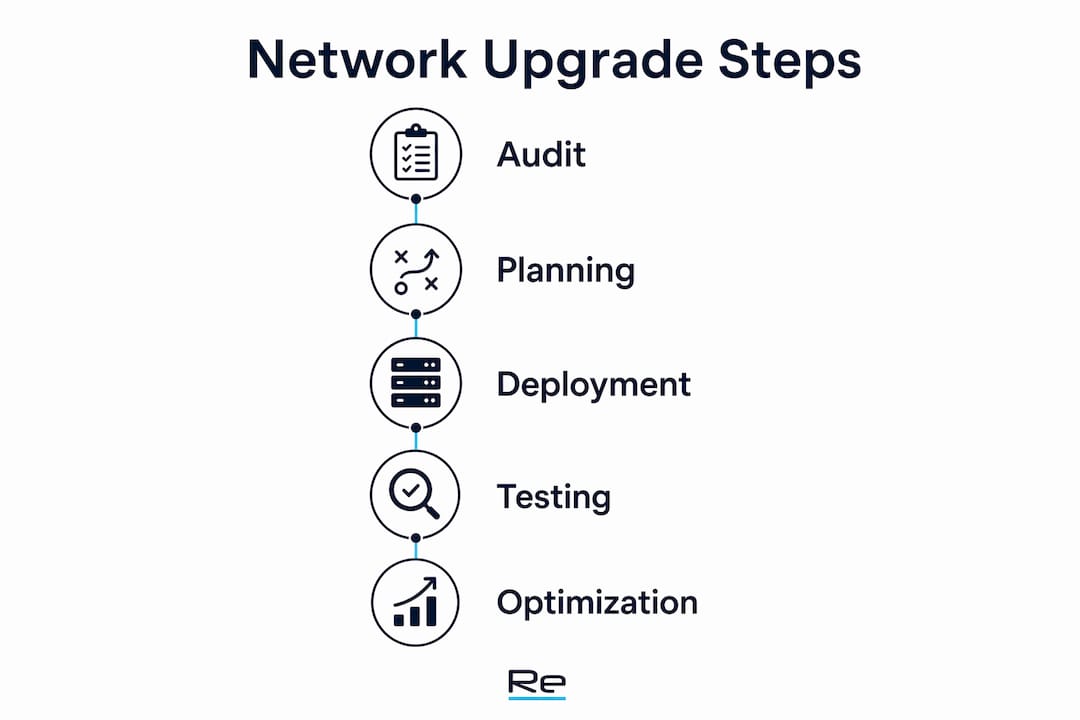
A phased approach — survey, pilot, staged roll-out, optimisation — reduces both risk and cost. Skipping the survey phase is the single most common cause of budget overruns.
Phased deployment checklist:
- Commission a professional network survey — assess physical cabling, backhaul capacity, site density, public spaces, guest rooms, external areas, and service rooms. Good network cabling practices at this stage prevent costly remediation later.
- Define VLAN and segmentation architecture — guest, staff, IoT, and payment segments mapped before any hardware is ordered.
- Select pilot property — choose a representative site (mid-size, mixed indoor/outdoor) and define success criteria: uptime, throughput, support ticket volume, guest satisfaction scores.
- Run the pilot — typical duration is four to six weeks. Validate AP placement, backhaul performance, and cloud dashboard visibility.
- Stage the roll-out — deploy remaining properties in waves of two to five sites, applying lessons from the pilot. Full estate roll-outs usually require several months depending on estate size and cabling condition.
- Optimise — use cloud analytics to identify coverage gaps, rogue devices, and bandwidth hogs. Adjust channel plans and policies centrally.
Cost model considerations:
- CapEx: upfront hardware purchase suits organisations with capital budgets and long refresh cycles (typically five to seven years).
- OpEx / NaaS: monthly subscription covers hardware, software licences, and managed support. Preferred by operators managing cashflow across multiple sites.
One deployment insight worth noting: cloud planning tools and modern hardware have cut planned outdoor AP counts by 60% in real hospitality roll-outs while improving coverage. Do not order outdoor APs on a like-for-like basis from an old survey — re-model first.
Pro Tip: Run a network audit before finalising your hardware bill of materials. An independent audit routinely uncovers cabling faults, undocumented VLANs, and legacy devices that would otherwise cause delays mid-deployment.
What security and UK compliance requirements apply to hospitality networks?
Enforce segmentation and centralised policy to meet PCI DSS and GDPR expectations while reducing manual configuration errors across your estate.
Required security controls for UK hospitality:
- Network segmentation: POS and payment terminals on isolated VLANs, completely separated from guest Wi-Fi and staff networks.
- Centralised logging and retention: all authentication events, firewall logs, and DHCP records retained for audit purposes, with timestamps aligned to UK GDPR data handling obligations.
- Strong staff authentication: 802.1X or ZTNA-based access for staff devices, preventing credential sharing and lateral movement.
- Encrypted backhaul: IPsec or MACsec encryption on all WAN links and inter-site tunnels.
- Regular vulnerability scanning: automated scans scheduled through the cloud management platform, with findings fed into a risk register.
- Wireless intrusion prevention: cloud-based WIPS to detect rogue APs and mitigate threats in real time.
A SASE-style central policy engine, as deployed by Mitchells & Butlers, replaces manual site-by-site security configurations with a single rule set. That approach improves compliance posture and eliminates the configuration drift that accumulates when each venue manages its own firewall rules. Integrated security solutions that combine network segmentation with centralised logging are the practical baseline for any UK hospitality operator processing card payments.
Pro Tip: A unified cloud policy engine means a compliance change — such as a new PCI DSS requirement — is applied once and propagated automatically to every site. Manual, site-by-site updates are where errors occur.
How do you choose the right managed network provider?
Pick a partner with Cisco specialism, demonstrable hospitality experience, published SLAs, and a clear migration plan. Those four criteria eliminate most unsuitable vendors before you reach a shortlist.
Supplier evaluation checklist:
- Cisco partnership status and relevant certifications (Gold, Premier, or equivalent).
- Hospitality-specific case studies — ask for references from comparable property types.
- Pilot and staging methodology — does the provider offer a structured pilot before full commitment?
- Published SLA metrics: mean time to respond (MTTR), response times by severity, and 24/7 support availability.
- Multi-site management capability — single dashboard, consolidated reporting, and centralised change management.
- Reporting and visibility — what does the monthly service report contain, and how is it delivered?
- PMS and POS integration experience — can the provider demonstrate API-level connectivity with platforms such as Oracle OPERA Cloud?
- Pricing transparency — clear CapEx vs OpEx options, with no hidden licence or support fees.
Red flags to watch for:
- No hospitality references or case studies.
- Opaque SLAs with no defined response times.
- No site survey offered before hardware specification.
- A hardware-first sales approach with no discussion of cloud management or segmentation architecture.
A unified platform approach where PMS, booking, and network-level security are natively connected reduces integration gaps and long-term management overhead. Ask every shortlisted provider how they handle PMS API connectivity before signing a contract.
Why Re-solution for UK hospitality networking?
Re-solution is a Cisco-specialist provider with over 35 years of experience, offering NaaS, managed Cisco infrastructure, and hospitality project delivery across the UK.
Re-solution’s hospitality capability: Cisco partnership and certifications, published SLAs, structured pilot and survey methodology, and integration experience with PMS and POS systems — all delivered under a single managed service contract.
Proof points for IT decision makers:
- Cisco partnership with certifications covering core networking, wireless, SD-WAN, and security.
- Hospitality sector experience including network surveys, audits, and staged deployments for multi-site operators.
- Published SLAs with defined MTTR and 24/7 support escalation paths.
- NaaS subscription model that converts capital expenditure into a predictable monthly cost.
- Network survey and audit capability to baseline your estate before any hardware is committed.
- Integration experience with PMS and POS platforms, including API-level connectivity.
The next step is a discovery call and site survey. Re-solution scopes the survey, produces a high-level design, and provides a budget estimate before any procurement decision is made.
Key takeaways
A Cisco-led cloud-managed network delivered as a managed service (NaaS) is the most effective approach to reliable, secure, and scalable connectivity for UK hospitality organisations.
| Point | Details |
|---|---|
| Survey before you specify | Commission a professional network survey before ordering hardware to avoid over-provisioning and budget overruns. |
| Pilot first, then roll out | A four-to-six-week pilot on a representative property validates design decisions before estate-wide commitment. |
| Centralise security policy | A SASE-style cloud policy engine enforces PCI DSS and GDPR controls across all sites without manual per-venue configuration. |
| Choose OpEx / NaaS for cashflow | A NaaS subscription replaces unpredictable capital expenditure with a fixed monthly cost, suited to multi-site operators. |
| Re-solution as your Cisco partner | Re-solution offers Cisco-specialist NaaS, managed services, audits, and hospitality deployments across the UK. |
The part most IT leaders underestimate
The technical architecture for cloud networking in hospitality is well understood. Cisco Meraki, Catalyst, SD-WAN, and DNA Center are proven components. What consistently catches IT leaders off guard is not the technology — it is the physical estate.
Outdoor coverage planning is where most hospitality network projects lose time and money. Teams order access points on a like-for-like basis from a five-year-old survey, then discover that modern hardware and cloud-based RF planning tools would have reduced the required AP count substantially while delivering better coverage. That recalibration mid-project is expensive and disruptive.
Legacy security sprawl is the second pitfall. Multi-site hospitality estates often carry years of site-by-site firewall rules, undocumented VLANs, and shadow IT devices. A SASE-style central policy engine solves the forward problem, but the migration from legacy configurations requires a proper audit first. Skipping that audit to save time at the start almost always costs more time at the end.
On timelines: a realistic full estate roll-out for a mid-size hospitality group runs two to eight months. The pilot phase is not optional padding — it is where the design is validated and the deployment team learns the estate’s physical quirks. Operators who treat the pilot as a formality tend to encounter those quirks at scale, which is a harder problem to fix.
Talk to Re-solution about your hospitality network
Re-solution delivers hospitality-focused NaaS, network audits, and managed Cisco deployments for UK operators. The starting point is a free discovery call that covers your current estate, your compliance requirements, and your budget model.
A discovery engagement with Re-solution includes a physical site survey, a high-level network design, and a budget estimate — all before any procurement commitment. For multi-site operators evaluating infrastructure renovation alongside a network upgrade, that scoping work is where the real cost savings are identified.
Contact Re-solution to arrange your discovery call, or review the full NaaS service offering to understand the subscription model in detail. For a broader view of IT infrastructure challenges and how a managed partner mitigates them, the knowledge resources on the Re-solution site are a practical starting point for internal stakeholder conversations.
Useful sources and further reading
- Re-solution NaaS service page — full description of the Network as a Service subscription model and what is included.
- Re-solution hospitality sector page — sector-specific experience, case studies, and service descriptions for hospitality operators.
- Cloud networking definition: a guide for IT teams — technical primer suitable for sharing with procurement stakeholders during evaluation.
- Re-solution network audit service — details of the survey and audit methodology used before deployment.
- Cisco and Mitchells & Butlers case study — real-world example of SASE and Meraki deployed across a large UK hospitality estate.
- AWS: what is cloud networking? — vendor-neutral explanation of cloud networking concepts and virtual network components.
- Oracle OPERA Cloud PMS — details of the open API architecture used for PMS and POS integration.
Recommended
- Drive hospitality success with innovative IT solutions
- Understanding Cloud Networking: Expert Guide | Re-Solution
- Understanding Cloud Networking: Expert Guide | Re-Solution
- Cloud-managed networking guide for IT teams in 2026