TL;DR:
- Most facility managers view network infrastructure as a utility, but this approach overlooks its strategic role in smart buildings. Properly designed and secure networks enable integrated subsystems, energy efficiency, occupant comfort, and AI-driven management, while poorly managed networks increase risks and operational challenges. Early planning and standards-based architecture are essential for future-proofing and unlocking the full potential of smart building technology.
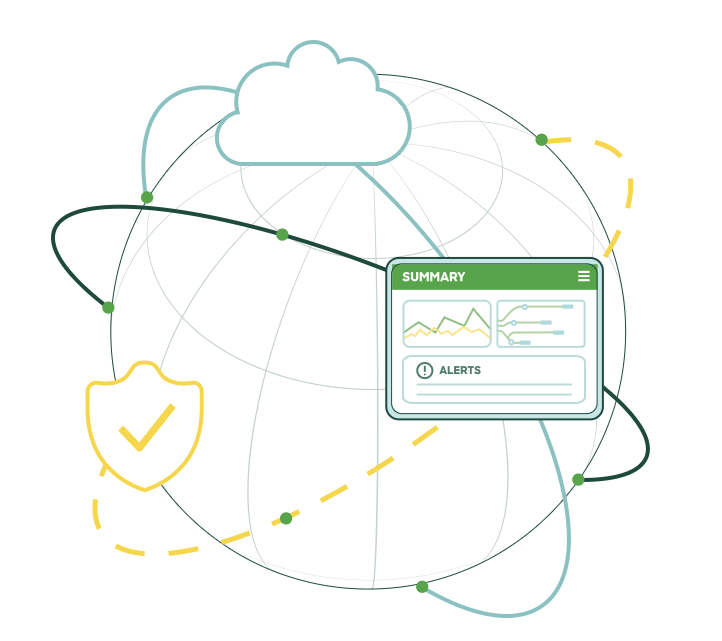
Most facility managers and IT professionals treat network infrastructure as a utility. You install it, it works, and you move on. That framing is costing buildings significant energy, money, and operational control. The role of networking in smart buildings extends far beyond basic connectivity. It is the underlying system that allows HVAC, lighting, security, IoT sensors, and building management platforms to share data, respond to conditions in real time, and operate as a single coordinated environment. This article examines the technical, operational, and strategic dimensions of smart building networking for the professionals responsible for making it work.
Table of Contents
- Key takeaways
- The role of networking in smart buildings: infrastructure foundations
- Networking and energy efficiency in smart buildings
- How networking enhances occupant comfort and building intelligence
- Security and resilience in smart building networks
- Future-proofing smart building networks for AI
- My perspective on what actually holds buildings back
- How Re-Solution can help with your smart building network
- FAQ
Key takeaways
| Point | Details |
|---|---|
| Networking is foundational | Advanced network infrastructure enables integration of all building subsystems, not just internet access. |
| Energy savings are measurable | Strategic network design can reduce Wi-Fi infrastructure energy use by up to 52% without compromising coverage. |
| IT/OT convergence creates risk | Merging operational and IT networks expands the attack surface and requires modern security protocols. |
| AI readiness depends on data structure | Connected buildings must provide structured, semantically tagged data for AI applications to function effectively. |
| Security requires layered design | Segmentation, certificate-based authentication, and monitoring are non-negotiable for smart building networks. |
The role of networking in smart buildings: infrastructure foundations
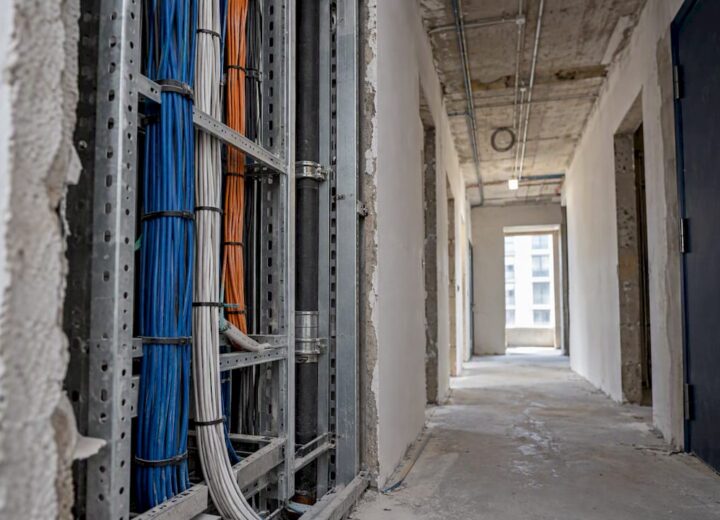
Smart building networking is not a single technology. It is a layered combination of wired and wireless systems, protocols, and architecture decisions that together determine how well a building can perform.
The core physical layer typically includes:
- Gigabit Ethernet and multi-gig switching for backbone connectivity between floors, plant rooms, and server infrastructure
- Power over Ethernet (PoE and PoE++) to supply power and data through a single cable to IP cameras, access points, VoIP handsets, and IoT sensors
- Wi-Fi 6 and Wi-Fi 7 access points for high-density wireless coverage across open-plan offices, lecture theatres, and shared workspaces
- Fibre uplinks between distribution and core switches to maintain throughput as device counts increase
At the protocol layer, building automation relies heavily on BACnet/IP to communicate between HVAC controllers, lighting systems, and building management software. Unlike standard IT protocols, BACnet/IP uses broadcast messaging across subnets, which introduces both performance limitations and security exposure at scale.
The convergence of IT networks and Operational Technology (OT) networks is where the real complexity begins. IT teams are accustomed to managing routers, firewalls, and user devices. OT networks have historically been air-gapped systems managing physical processes, often running proprietary firmware on hardware designed for 20-year lifespans. Merging these two environments onto shared IP infrastructure means a single network must now serve a security camera, a BMS controller, a laptop, and a wireless sensor simultaneously.
Network topology choices matter here more than most professionals realise. A flat network where all devices share broadcast domains creates performance degradation and security exposure as device counts grow. Structured designs using VLANs, layer 3 segmentation, and defined traffic paths between building systems provide both performance and containment. For connected smart building systems, this architectural discipline is the difference between a building that scales and one that develops reliability problems as more devices come online.
Networking and energy efficiency in smart buildings
Energy performance is where smart building networking delivers some of its most quantifiable returns, yet most facilities focus on the BMS or HVAC hardware and overlook the network itself as an energy consumer and enabler.

The wireless infrastructure in a large commercial building or campus runs continuously, with access points maintaining radio coverage around the clock regardless of occupancy. Interference-aware spatial coordination frameworks can reduce annual operational energy use from approximately 1,892 kWh to 1,333 kWh per deployment, a reduction of 29.5%, whilst simultaneously improving signal quality and increasing median network capacity by 30.6%. That is not a marginal gain. It is the result of treating network topology as an energy variable rather than a fixed constant.
Context-aware power optimisation takes this further. Frameworks such as FuzzyGreen apply fuzzy logic to dynamically adjust radio power states based on occupancy data, time of day, and traffic load. Research shows these approaches can cut Wi-Fi energy consumption by between 38% and 52% compared to always-on configurations, with an inference time of just 0.23 milliseconds, making them compatible with standard access point hardware.
The mechanism that produces the largest savings is not fine-tuning individual access point power profiles. Significant energy reductions come from topology decisions and shutting down physical switch ports during unoccupied hours rather than incremental power adjustments at the radio level. This means that energy savings are an architectural and scheduling problem as much as a hardware one.
Pro Tip: When auditing a building’s wireless infrastructure for energy performance, start by mapping which switch ports remain active overnight and at weekends. Disabling unused ports on access layer switches during low-occupancy periods often produces more measurable savings than any access point power setting.
Beyond the network’s own consumption, well-designed networking enables the BMS and IoT platforms to gather precise occupancy and environmental data that drives energy decisions across all building services. HVAC systems that can receive real-time sensor data via a reliable network can reduce conditioning in unoccupied zones immediately. Lighting systems on PoE networks can dim or power off based on presence detection. The network is the delivery mechanism for every data-driven efficiency measure in the building.
How networking enhances occupant comfort and building intelligence
Occupant comfort in a modern building is not a static target. It varies by zone, time of day, activity type, and individual preference. Delivering it consistently requires continuous data collection, fast processing, and automated responses. None of that is possible without reliable, low-latency networking throughout the building.
IoT sensors are the data collection layer. A typical smart building deployment includes sensors monitoring:
- Air quality (CO2, VOCs, particulate matter) across occupied zones
- Temperature and humidity at zone level rather than floor level
- Occupancy and desk utilisation via motion sensors and Wi-Fi presence detection
- Lighting levels with daylight harvesting controls tied to network-connected dimmers
- Noise levels in open-plan areas to trigger acoustic management responses
These sensors generate continuous data streams that must reach either edge compute hardware or cloud platforms for processing. The network determines how quickly that data arrives and how reliably it does so under load. In a dense deployment with hundreds or thousands of endpoints, Quality of Service (QoS) configuration on the network becomes critical. Without it, sensor telemetry competes with video surveillance traffic and user Wi-Fi, and response times degrade.
AI-enabled building management platforms are increasingly common, and they depend on microservices architectures that process data from multiple subsystems concurrently. These platforms learn occupancy patterns, predict demand, and adjust building conditions proactively rather than reactively. The quality of their outputs depends directly on the consistency and completeness of the data the network delivers. A gap in connectivity from a poorly designed wireless cell or an overloaded switch port does not just create a brief service interruption. It creates a data gap that corrupts the learning model.
Buildings with high-quality digital connectivity certification command up to £5.00 per square foot in rental premiums and maintain notably lower vacancy rates, demonstrating that occupant experience and network quality are directly linked in the commercial property market.
Security and resilience in smart building networks
The importance of networking in buildings extends to security, and this is where many facilities carry the most unaddressed risk. IT/OT convergence does not just create operational opportunity. It creates exposure.
Legacy BACnet/IP networks were designed for isolated environments. They lack encryption and rely on broadcast-based communication, which means any device on the subnet can receive and potentially inject BACnet messages. As these systems move onto shared IP infrastructure, the attack surface expands considerably. A compromised IoT sensor on the same broadcast domain as a BMS controller is a realistic threat vector.
Addressing this requires a layered approach:
- Adopt BACnet Secure Connect (BACnet/SC) where possible. BACnet/SC replaces the broadcast model with a hub-and-spoke architecture using TLS 1.3 and X.509 certificates, eliminating broadcast storms and message injection attacks. It requires PKI management, but that overhead is justified by the security improvement.
- Implement 802.1X port-based authentication on all access layer switch ports to prevent unauthorised devices from joining building networks.
- Apply microsegmentation using AI-powered device fingerprinting. Machine learning establishes behavioural baselines for each device type and restricts communication to expected patterns, limiting lateral movement if a device is compromised.
- Deploy centralised logging and monitoring with alerts tied to IEC 62443 security zone definitions, providing audit trails and compliance evidence.
- Segment IoT, OT, and IT traffic into separate VLANs with firewall rules controlling inter-zone communication, so a compromised building sensor cannot reach corporate systems.
Pro Tip: Do not assume that a device is safe because it is wired. Physical access to a switch port in a plant room or riser cabinet is a common attack vector in building networks. Port security, 802.1X, and physical cabinet locks should be treated as a combined control.
For guidance on building these controls into your network architecture from the ground up, Re-Solution’s resource on building a secure network covers the frameworks and practical steps relevant to converged building environments.
Future-proofing smart building networks for AI
Being connected is no longer sufficient. Networks must deliver structured, interoperable data for AI applications to function in smart buildings. This is the distinction most facilities have not yet grasped.
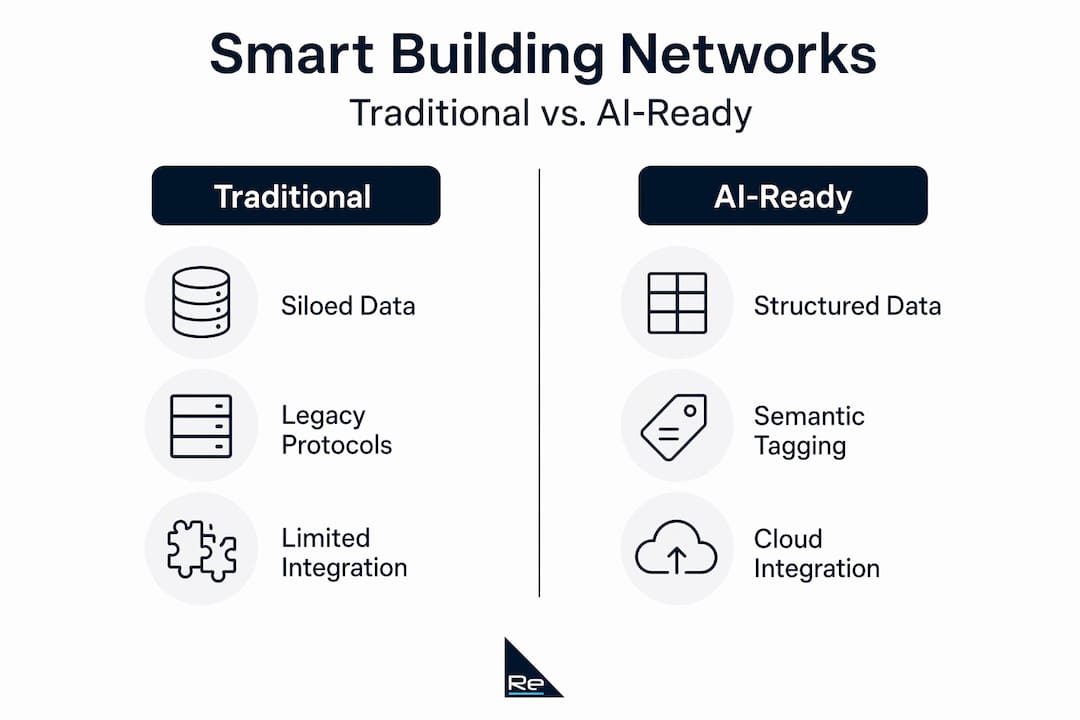
| Traditional connected building | AI-ready smart building |
|---|---|
| Data collected in proprietary silos | Data structured using open standards (e.g., ASHRAE 223P) |
| Systems integrated via point-to-point links | Systems integrated via knowledge graphs and semantic tagging |
| Reactive management based on alerts | Predictive management based on continuous learning |
| Network designed for current device count | Network architecture designed for continuous expansion |
| Security added after deployment | Security embedded in network design from day one |
ASHRAE 223P introduces semantic tagging for building systems, allowing AI platforms to understand what a data point represents, not just its numerical value. A temperature reading tagged with its zone, system type, and relationship to adjacent sensors becomes vastly more useful than a raw number. But this only works when the network delivers accessible, standardised data that AI systems can query across subsystems without proprietary translation layers.
For facility managers and IT professionals, this means that network procurement decisions made today will determine what AI-assisted building management is possible in three to five years. Architecture that locks data into vendor-specific formats limits future options significantly. Open, standards-based network designs that support knowledge graph integration keep those options open.
Smart building networking must be treated as a strategic digital ecosystem that integrates networking, cloud strategy, and cybersecurity as interdependent components, not separate procurement decisions. The role of connectivity in smart campuses and large commercial estates is evolving in exactly this direction, with cross-department collaboration between IT, facilities, and sustainability teams becoming a functional requirement rather than a best practice.
My perspective on what actually holds buildings back
I’ve seen a consistent pattern across smart building projects. The technology is rarely the limiting factor. The problem is that networking decisions get made in isolation. Facilities teams specify a BMS. IT teams design a corporate network. A separate contractor installs the IoT infrastructure. Nobody owns the intersections.
What I’ve learned from working at that convergence point is that the gaps between systems are where failures occur. A perfectly configured BMS talking to a poorly segmented network produces unreliable data. An AI platform fed by inconsistent sensor telemetry makes poor decisions. The technical components are often individually sound. The integration is where the risk sits.
The other pattern I’ve observed is that security is treated as a final checklist item rather than a design constraint. In my experience, retrofitting security controls onto a flat, unsegmented building network is significantly harder and more disruptive than building them in from the start. The protocols exist. BACnet/SC, 802.1X, and proper VLAN design are not exotic or costly. They just require early planning.
Facility managers who understand networking at a conceptual level, not necessarily a technical one, consistently make better decisions about vendors, contracts, and system integrations. That knowledge is becoming part of the role, not an optional extra.
— Jacob
How Re-Solution can help with your smart building network

Re-Solution has over 35 years of experience designing and managing Cisco IT infrastructure for complex, multi-system environments. Whether you are looking to audit your current network, design a secure architecture for IT/OT convergence, or build the connectivity foundation for AI-assisted building management, Re-Solution has the expertise to help you do it properly.
Explore Re-Solution’s IT infrastructure resources for a grounded understanding of the principles that underpin smart building connectivity, or review the guidance on modernising IT infrastructure to see what upgrading to a future-ready network looks like in practice. For organisations that prefer a managed approach, Re-Solution’s Network as a Service offering provides ongoing management of your network infrastructure without the overhead of in-house resource. Get in touch with the Re-Solution team to discuss your building’s specific requirements.
FAQ
What is the role of networking in smart buildings?
Networking is the foundational layer that connects all building subsystems, including HVAC, lighting, security, and IoT sensors, enabling them to share data, respond to conditions automatically, and be managed from a central platform.
How does networking reduce energy consumption in smart buildings?
Strategic network design, including interference-aware topology and context-aware power management, can reduce Wi-Fi infrastructure energy use by 29.5% to 52% whilst maintaining or improving coverage and network capacity.
What security risks come with IT/OT convergence in buildings?
Merging IT and OT networks expands the attack surface, particularly when legacy protocols like BACnet/IP are used without segmentation or authentication. Adopting BACnet/SC, 802.1X, and microsegmentation significantly reduces these risks.
Why is structured data important for smart building AI?
AI applications require data that is semantically tagged and accessible across systems. Buildings that store data in proprietary silos cannot support AI-driven management effectively, regardless of how many sensors or connected devices they have.
How does networking affect occupant comfort?
Reliable, low-latency networking allows IoT sensors to deliver continuous environmental data to building management platforms, enabling automated adjustments to temperature, air quality, lighting, and noise levels in response to real-time occupancy conditions.
Recommended
- Smart Building Technologies Enhance Security | Re-Solution
- Smart building technology for operational efficiency
- Designing Smart Buildings with Security | Re-Solution