TL;DR:
- Getting digital building infrastructure right from the start saves costs and ensures long-term system functionality. Early coordinated planning across architecture, IT, and operations, grounded in recognized standards, prevents costly retrofits and operational issues. Continuous validation, stakeholder involvement, and proactive cybersecurity are essential for optimal performance throughout the building’s lifecycle.
Getting digital building infrastructure wrong costs far more than getting it right the first time. Poor connectivity planning, mismatched protocols, and siloed systems are among the most common complaints from facility managers and IT teams inheriting buildings that looked impressive on paper. Understanding how to design digital building infrastructure requires more than selecting the right devices. It demands coordinated planning across architecture, IT, and operations from the earliest project stage, grounded in recognised frameworks and interoperability standards that keep systems functional well beyond handover.
Table of Contents
- Key takeaways
- Planning foundations for digital building infrastructure
- Designing the digital infrastructure: components and integration
- Implementation best practices and pitfalls to avoid
- Verifying and optimising performance across the building lifecycle
- My perspective on the project-operations gap
- How Re-solution can support your digital building project
- FAQ
Key takeaways
| Point | Details |
|---|---|
| Start with a smart-level definition | Decide how smart the building needs to be before selecting any technology, as early decisions shape all later outcomes. |
| Use recognised frameworks | Align design to the RIBA Smart Buildings Overlay to keep digital infrastructure embedded across every lifecycle stage. |
| Prioritise interoperability | Specify BTL-certified BACnet devices with PICS documentation to avoid costly multi-vendor integration failures. |
| Involve FM from day one | Facility managers must inform technology choices early, not receive a handover pack at the end. |
| Validate and optimise continuously | Commissioning is not the finish line. Establish KPIs and feedback loops to improve performance throughout the building lifecycle. |
Planning foundations for digital building infrastructure
Before any design work begins, you need clarity on what digital building infrastructure actually means for your specific project. Digital building infrastructure refers to the integrated network of communication systems, sensors, control platforms, and data management tools that enable a building to monitor, respond to, and report on its own performance. This covers everything from HVAC controls and lighting management through to access control, occupancy sensing, and energy monitoring.
The RIBA Smart Buildings Overlay framework provides the most practical starting point for UK projects. It embeds digital infrastructure as a core component throughout the building lifecycle, with defined milestones for data strategy, system design, and operational handover. Rather than treating connectivity as a late-stage fit-out item, the framework positions it alongside structural and mechanical design from Stage 0.
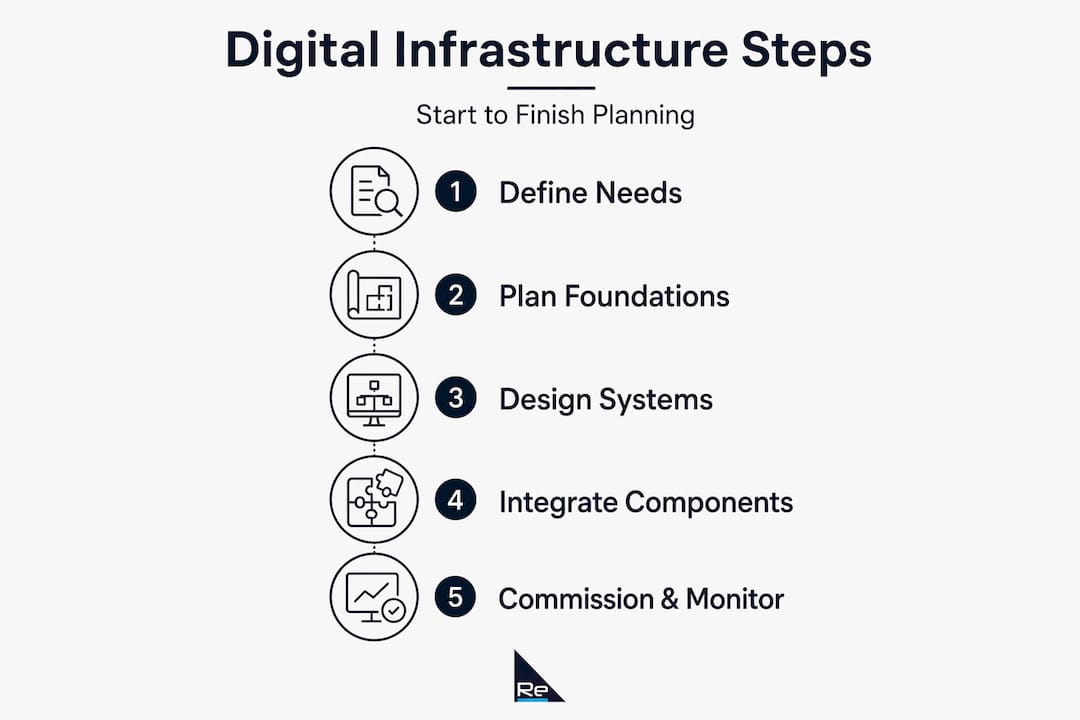
Stakeholder alignment is where most projects either gain traction or lose it. Architects, IT teams, facility managers, and end users all have different priorities and vocabularies. Getting these groups into the same conversation early prevents the recurring problem of IT designing a network the BMS contractor cannot connect to, or a facilities team receiving a building management system with no operational documentation.
Before detailed design begins, clarify the following:
- Project objectives: Define what the building is expected to do. Energy reporting, occupancy analytics, predictive maintenance, and tenant experience are distinct goals requiring different infrastructure choices.
- Smart level: Early-stage decisions on how smart the building should be directly influence success metrics and operational effectiveness far more than technology added later.
- Infrastructure components: Identify the network layers, sensor types, edge computing requirements, and integration platforms relevant to your goals.
- Operational data needs: Understand what data the FM team needs on day one of occupation, not just what the project team wants to deliver.
- Protocol selection: Determine which communication protocols are required. BACnet, Modbus, KNX, and LonWorks each have different interoperability implications.
Pro Tip: Map out the operational use cases first, then work backwards to the technology. A building that needs predictive maintenance analytics will require a very different sensor density and data architecture than one focused solely on energy compliance reporting.
Integrating smart building design considerations from the earliest design stages prevents the far more expensive task of retrofitting digital systems into a structure that was never planned to accommodate them.
Designing the digital infrastructure: components and integration
With planning foundations in place, the design phase translates objectives into a coherent technical architecture. This involves five deliberate steps.
-
Select communication networks aligned to system requirements. BACnet supports Ethernet, Wi-Fi, and twisted pair, enabling it to integrate HVAC, lighting, security, and fire detection into a unified management system. MS/TP is appropriate for cost-sensitive field device networks, whilst BACnet/IP suits backbone communication and integration with IT networks.
-
Plan network segmentation and device addressing. Effective BACnet networks use VLANs for traffic segmentation, BBMD (BACnet Broadcast Management Device) for multi-subnet communication, and must maintain unique device instance numbers across all controllers. Poorly managed address conflicts cause discovery failures that are difficult to diagnose post-commissioning.
-
Design sensor and actuator layouts against operational goals. Place sensors where they will capture meaningful data, not simply where installation is convenient. Occupancy sensors positioned in corridors tell you very little about zone utilisation. CO₂ sensors mounted too close to ventilation diffusers produce readings that misrepresent actual air quality.
-
Establish semantic interoperability and data standardisation. Interoperability is evolving from basic protocol communication to semantic understanding of shared data models across building systems. Agreeing on point naming conventions, unit standardisation, and metadata tagging at design stage makes integration with analytics platforms and BIM models significantly more reliable.
-
Align design deliverables to RIBA Plan of Work stages. Produce network topology drawings at Stage 3, detailed device schedules and protocol specifications at Stage 4, and integration test plans at Stage 5. This gives contractors clear deliverables and reduces scope for misinterpretation.
| Design element | Recommended approach | Common mistake |
|---|---|---|
| Network topology | BACnet/IP for backbone, MS/TP for field devices | Using a single flat network for all device types |
| Device addressing | Unique instance numbers, documented centrally | Duplicate addresses causing discovery conflicts |
| Sensor placement | Positioned for operational accuracy | Placed for installation convenience only |
| Naming conventions | Standardised metadata tagging from Stage 3 | Inconsistent naming applied post-commissioning |
| Security segmentation | VLANs and firewall rules for OT/IT separation | Shared network between BMS and corporate IT |
Pro Tip: Require that all BACnet integration points are documented in a master point schedule during design, not retrospectively during commissioning. Retrofitting this documentation adds time and cost, and the results are rarely as accurate.
Implementation best practices and pitfalls to avoid
Good design only delivers value if implementation follows through on the intent. The gap between a well-designed specification and a functional installed system is where many digital building projects lose performance.

Start with procurement discipline. Requesting PICS documents and BTL certification before purchasing BACnet devices is not optional. PICS (Protocol Implementation Conformance Statement) verifies which object types and services a device supports. Without it, you may specify a device that claims BACnet compatibility but lacks the specific services your BMS requires, leading to integration failures that surface only during commissioning.
Commissioning itself should follow a defined sequence:
- Device discovery: Confirm all devices are visible on the network before proceeding.
- Read/Write validation: Test ReadProperty and WriteProperty functions for every point in the schedule.
- COV configuration: Change of Value subscriptions reduce network traffic by notifying controllers only when a value changes meaningfully. This is particularly important in large sensor deployments where constant polling creates significant network load.
- Integration testing: Verify that data flows correctly between field devices, the BMS, and any connected analytics or reporting platforms.
- Documentation handover: Confirm that as-built records, device configurations, and point schedules are complete before practical completion.
Cybersecurity is not a post-installation concern. NIST guidance recommends layered security for IoT devices to mitigate unauthorised access and system disruption risks. Building control systems, once air-gapped by default, are now routinely connected to enterprise networks and cloud platforms. This expands the attack surface considerably. Applying network access control, protecting IoT and automation systems with segmentation and authentication, and establishing clear patch management responsibilities are baseline requirements for any modern digital building.
Integrating FM workflows during early design prevents the project-operations gap and maximises building performance by ensuring operational data needs guide technology choices and handover quality.
Finally, plan for change. Technology cycles in building automation are shorter than building lifespans. Specify infrastructure with upgrade pathways in mind. Use open protocols where possible, avoid proprietary lock-in on critical integration layers, and document decommissioning procedures for every device category.
Verifying and optimising performance across the building lifecycle
Installation and commissioning mark the beginning of operational performance management, not the end of the design process. Smart buildings are constantly evolving entities requiring lifecycle planning that includes continuous feedback and systematic asset management.
Establish success criteria before occupation. These should be quantifiable and operationally meaningful:
| Performance area | Example KPI | Review frequency |
|---|---|---|
| Energy consumption | kWh per m² per month against baseline | Monthly |
| HVAC responsiveness | Zone set-point achieved within 15 minutes | Quarterly |
| System availability | BMS uptime above 99.5% | Monthly |
| Data completeness | Less than 2% missing data points per sensor | Weekly |
| Fault response time | Automated alert to resolution under 4 hours | Per incident |
Digital twin frameworks add significant value at this stage. NIST advocates using digital twin frameworks for operational analytics and optimisation, enabling teams to model interventions before applying them to live systems. This reduces the risk of operational disruption when tuning control sequences or adjusting setpoints.
Feedback loops between the technical delivery team and FM are not automatic. You need to build them explicitly into contract terms and operational governance. A quarterly review between the BMS contractor, network team, and FM leads, structured around the KPIs above, produces continuous improvement rather than a steady decline in system performance as occupied conditions diverge from design intent.
Advanced analytics and AI-assisted fault detection are becoming practical tools in this space. They work best when using standardised naming conventions and canonical documentation that make device data readable and consistent. Analytics platforms cannot identify anomalies in sensor data that is labelled inconsistently or missing unit metadata.
Pro Tip: Maintain a living device and network inventory from day one of commissioning. Update it whenever devices are added, replaced, or reconfigured. This single discipline saves more time over a building’s lifecycle than almost any other operational practice.
My perspective on the project-operations gap
In my experience, the single biggest failure mode in digital building infrastructure is not a technology problem. It is a handover problem. I have seen well-specified, carefully designed systems deliver a fraction of their intended value because the facility management team received a complex BMS with minimal training, incomplete documentation, and no understanding of what the system was built to achieve.
The project-operations gap is predictable and preventable. What I have found actually works is treating FM as a design stakeholder from Stage 1, not a recipient at Stage 6. When the people who will operate the building help define what operational success looks like, the technology choices that follow are almost always better calibrated.
I would also challenge the assumption that a more feature-rich system is always a better one. Smart building infrastructure requires continuous and collaborative design rather than a static plan handed over at practical completion. In my view, an agile and iterative approach, where systems are validated against real occupancy data and adjusted accordingly, produces better outcomes than a rigid specification that nobody revisits after commissioning. The buildings that perform best over ten years are rarely the ones with the most sensors. They are the ones where the design team asked the right questions about future-proofing IT infrastructure before specifying anything.
— Jacob
How Re-solution can support your digital building project
Whether you are planning a new build or bringing legacy infrastructure up to current standards, Re-solution brings over 35 years of Cisco networking expertise to digital building projects across education, hospitality, manufacturing, and property development.

Re-solution designs and delivers IT infrastructure that underpins smart building operations, from network architecture and security segmentation through to managed services and ongoing performance support. If you are working through the design decisions covered in this article and need a technically experienced partner to validate your approach or fill capability gaps, Re-solution’s team is available for consultation. Explore IT infrastructure guidance or contact Re-solution directly to discuss your project requirements.
FAQ
What is digital building infrastructure?
Digital building infrastructure is the integrated network of communication systems, sensors, control platforms, and data management tools that enable a building to monitor and manage its own performance. It typically includes BMS networks, IoT sensors, connectivity layers, and analytics platforms.
Why invest in digital infrastructure for buildings?
Digital infrastructure reduces operational costs, improves energy efficiency, and provides data-driven insights for maintenance and compliance. Early investment in design avoids expensive retrofit work and supports occupant performance goals throughout the building lifecycle.
What is the RIBA Smart Buildings Overlay?
The RIBA Smart Buildings Overlay is a framework that embeds digital infrastructure planning across all stages of the RIBA Plan of Work. It provides structured milestones for data strategy, system design, and operational handover to prevent digital systems being treated as afterthoughts.
What is BTL certification and why does it matter?
BTL (BACnet Testing Laboratories) certification confirms that a device has been independently tested for compliance with the BACnet standard. Specifying BTL-certified devices with PICS documentation reduces the risk of multi-vendor integration failures during commissioning.
How do you future-proof digital building infrastructure?
Use open protocols such as BACnet/IP, specify modular and upgradeable components, document all device configurations centrally, and plan decommissioning pathways from the outset. Avoid proprietary lock-in on critical integration layers wherever possible.
Recommended
- Designing Smart Buildings with Security | Re-Solution
- Network Infrastructure Planning Simplified | Re-Solution
- Network Infrastructure Planning Simplified | Re-Solution