TL;DR:
- Effective network architecture combines physical precision, logical clarity, and security from the start. Proper planning ensures networks are reliable, scalable, and adaptable to future demands.
Network architecture is defined as the structured design and organisation of a computer network’s components, including devices, cabling, protocols, and security controls. Understanding network architecture basics gives IT professionals and students the framework to build networks that are reliable, secure, and capable of growing with demand. The field draws on established models such as the hierarchical three-tier design (access, distribution, and core layers), alongside principles like modularity, redundancy, and Zero Trust security. Getting these fundamentals right from the outset determines whether a network supports the business or constrains it.
What are the fundamental principles of network architecture design?
Effective network design rests on three core principles: scalability, availability, and manageability. Each principle addresses a different failure mode that organisations encounter as their networks grow.
Scalability means the network can absorb new devices, users, and services without requiring a full redesign. A network built without scalability in mind forces costly forklift upgrades when demand increases. Modular design solves this by dividing the network into discrete segments that can be upgraded independently.
Availability refers to keeping the network operational despite hardware failures or link outages. Redundancy techniques such as dual uplinks, failover routing protocols, and uninterruptible power supplies address this directly. A network with no redundancy is a single point of failure waiting to cause a business outage.
Manageability covers how easily the network can be monitored, configured, and documented. Centralised management tools and consistent naming conventions reduce the time engineers spend diagnosing faults. Clear documentation is not optional; it is the foundation that makes every other principle work in practice.
- Scalability: design for growth by segmenting the network into upgradeable modules
- Availability: build redundancy into links, power, and routing to maintain uptime
- Manageability: use centralised tools and maintain accurate, current documentation
- Modularity: isolate network functions so changes in one area do not break another
- Security by design: embed access controls and monitoring from the start, not as an afterthought
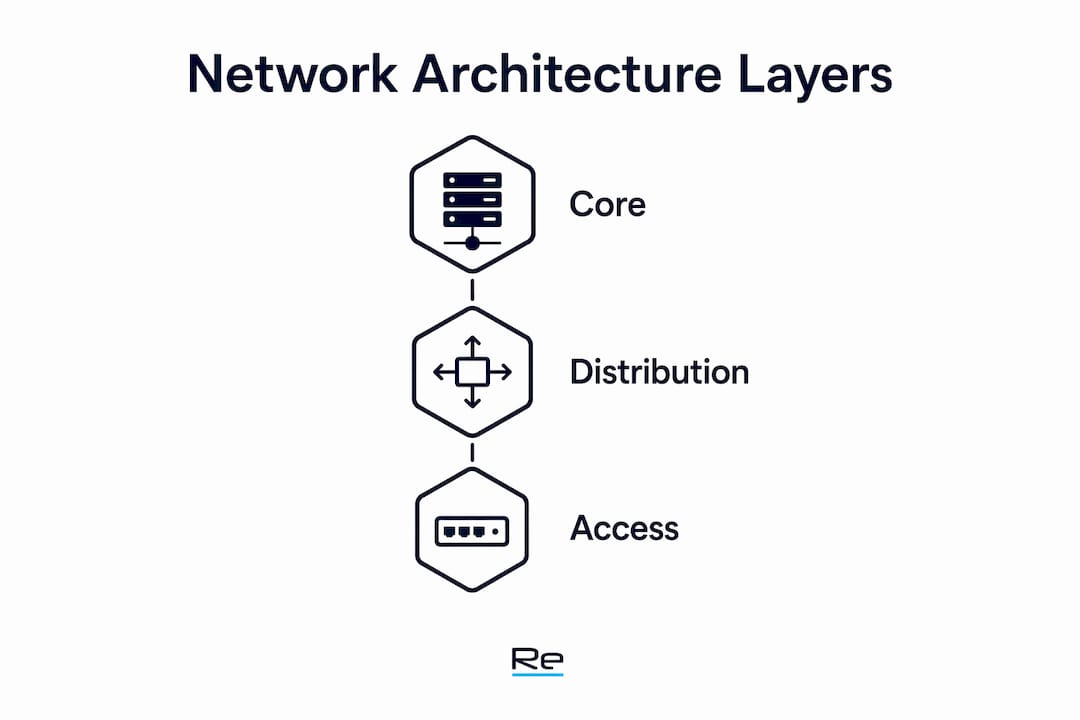
The hierarchical three-tier model (access, distribution, and core) is the foundational design standard for enterprise networks. It separates functions into distinct layers, making troubleshooting and upgrades far simpler than flat architectures allow.
Pro Tip: Document your design decisions as you build, not after. A diagram created six months later from memory will contain errors that cause real outages.
How do physical and logical architectures differ?
Physical and logical architecture are two distinct layers of network design, and both must be planned deliberately. Treating one as secondary to the other is a common and costly mistake.
Physical architecture: the hardware layer
Physical architecture covers the tangible components: cabling, switches, routers, patch panels, rack placement, and power distribution. Physical layer design decisions such as cable category, rack placement, and documentation directly affect bandwidth capacity, troubleshooting ease, and the network’s ability to scale. Poor physical design creates interference and bottlenecks that no software change can fix. A Cat5e cable run in a high-interference environment will underperform regardless of how well the logical layer is configured.

Logical architecture: the protocol layer
Logical architecture defines how data moves across the physical infrastructure. It includes IP addressing schemes, VLAN segmentation, routing protocols, and access control lists. Logical design overlays the physical topology and determines which devices can communicate with which, and under what conditions. A well-structured IP addressing plan, for example, makes subnetting and firewall rule management significantly easier as the network grows.
Why coordinated planning matters
The two layers must be designed together. A logical VLAN structure that requires traffic to traverse three physical switches unnecessarily adds latency and complexity. Coordinated planning avoids these mismatches.
The steps below outline a structured approach to physical and logical planning:
- Audit existing physical infrastructure before designing logical overlays. Identify cable runs, port mappings, and device locations.
- Define the IP addressing scheme based on the number of devices, growth projections, and segmentation requirements.
- Map VLANs to physical switch ports to confirm the logical design is achievable with the physical hardware in place.
- Document both layers in a single source of truth. Failing to document physical connections leads to prolonged troubleshooting and avoidable downtime.
- Review and update documentation after every change, not during the next incident.
Pro Tip: Use a network diagramming tool that supports both physical and logical views simultaneously. Keeping them in separate documents leads to version drift and contradictions.
What are the common network architecture models?
Three models dominate network architecture planning: client-server, peer-to-peer, and hierarchical. Each suits different environments, and choosing the wrong one creates problems that compound over time.
Client-server model
The client-server model uses dedicated servers to provide services, storage, and authentication to client devices. It suits environments requiring centralised control, consistent security policies, and resource allocation. Schools, hospitals, and enterprise offices typically use this model because it allows administrators to manage permissions and data from a single point. The trade-off is cost: servers, licences, and the expertise to manage them add up quickly.
Peer-to-peer model
Peer-to-peer networks treat all devices as equals, with no dedicated server. Each device shares resources directly with others. This model suits small environments with fewer than 10 devices where simplicity and low initial cost matter more than centralised control. As the network grows, security and management become increasingly difficult to maintain without a dedicated server infrastructure.
Hierarchical three-tier model
The hierarchical model divides the network into three distinct layers: core (high-speed data transfer), distribution (policy enforcement and routing), and access (end-device connectivity). Each layer can be upgraded independently, which makes this model the standard choice for enterprise environments. It offers the clearest path to scalability and the most straightforward troubleshooting process.
| Model | Best environment | Key strength | Key limitation |
|---|---|---|---|
| Client-server | Enterprise, education, healthcare | Centralised control and security | Higher cost and complexity |
| Peer-to-peer | Small offices, home networks | Simple setup, low cost | Poor scalability and security |
| Hierarchical three-tier | Enterprise, campus networks | Modular, scalable, easy to troubleshoot | Requires careful initial planning |
Factors that determine model choice include network size, security requirements, available budget, and the performance expectations of the applications running on the network. A manufacturing site with 200 devices and strict access controls needs a client-server or hierarchical approach. A small shared workspace with eight devices can operate effectively on a peer-to-peer model.
What role does security play in network architecture?
Security is not a layer added after the network is built. Security and management layers including firewalls, intrusion detection systems, access controls, and monitoring tools must be integrated into the architecture from the outset. Retrofitting security onto an existing design is expensive, disruptive, and rarely as effective as building it in from day one.
A secure network architecture addresses threats at multiple points rather than relying on a single perimeter defence. The components that belong in every architecture include:
- Firewalls: enforce traffic policies at network boundaries and between internal segments
- Access control lists (ACLs): restrict which devices and users can reach specific resources
- Intrusion detection and prevention systems (IDS/IPS): monitor traffic for known attack patterns and block threats in real time
- Network Access Control (NAC): verifies device compliance before granting network access, a critical control in environments with BYOD or guest access
- Centralised monitoring: provides visibility across the entire network, enabling faster detection and response
Zero Trust is the architectural principle that no device or user is trusted by default, regardless of whether they are inside or outside the network perimeter. Applying Zero Trust principles at the design stage means segmentation, authentication, and least-privilege access are built into the fabric of the network rather than bolted on later.
Consistent security policies embedded in the architecture also simplify compliance audits. When controls are documented and enforced at the design level, demonstrating compliance to frameworks such as ISO 27001 or Cyber Essentials becomes a structured process rather than a reactive scramble.
How does good architecture support evolving business needs?
Modern network architecture must be designed for evolution, allowing new services and capacity increases without replacing core infrastructure. This is the difference between a network that supports the business and one that constrains it.
Modular design is the primary mechanism for achieving this. When each layer of the network has a defined function and clear interfaces to adjacent layers, adding capacity or introducing a new service does not require touching the entire infrastructure. A new building wing, a cloud migration, or the addition of IoT devices can each be accommodated by extending the relevant module rather than redesigning the whole.
“Architecture enabling service evolution without core replacement is not a luxury for large enterprises. It is the baseline expectation for any network built to last more than three years.”
Flexible deployment architectures, including Network as a Service (NaaS), allow organisations to scale capacity on demand without the capital expenditure of purchasing and provisioning hardware upfront. This model suits organisations whose network demands fluctuate, such as hospitality venues, logistics operations, and educational institutions with seasonal peaks.
Infrastructure planning that accounts for future services from the start avoids the expensive and disruptive cycle of emergency upgrades. Documenting the architecture as a living record, updated after every change, is what makes long-term evolution manageable rather than chaotic.
Key takeaways
Sound network architecture combines physical precision, logical clarity, and security integration to produce a network that performs reliably and adapts without constant redesign.
| Point | Details |
|---|---|
| Design principles first | Base every network on scalability, availability, and manageability before selecting hardware. |
| Physical layer matters | Cable category, rack placement, and documentation directly affect performance and troubleshooting speed. |
| Match model to environment | Use peer-to-peer for small networks, client-server for centralised control, and hierarchical for enterprise scale. |
| Security belongs in the design | Firewalls, NAC, IDS/IPS, and Zero Trust controls must be embedded from the outset, not added later. |
| Plan for evolution | Modular, documented architectures allow new services and capacity to be added without core replacement. |
The physical layer is still the most underestimated part of network design
After years of working with IT teams across education, manufacturing, and logistics, the pattern I see most consistently is this: professionals who are confident with protocols and logical design routinely underestimate the physical layer. They spend hours diagnosing a performance issue that turns out to be a degraded cable run or a switch installed in a poorly ventilated cabinet.
The physical layer is the most common design failure point causing troubleshooting delays. That finding matches what I observe in practice. A network with a flawless logical design will still underperform if the physical foundation is compromised.
My advice to IT professionals building their foundational knowledge is to resist the urge to skip ahead to advanced topics like SD-WAN or Zero Trust architecture before you are genuinely comfortable with the physical and logical basics. The advanced concepts make far more sense when you understand what they are abstracting. Equally, do not treat documentation as a task for quieter periods. The teams that recover fastest from outages are the ones with accurate, current diagrams, not the ones with the most experienced engineers.
Simplicity is also underrated. The most maintainable networks I have encountered are not the most technically sophisticated. They are the ones where every design decision has a clear reason, every cable is labelled, and every VLAN has a documented purpose.
— Jacob
Re-solution’s approach to network infrastructure design
Re-solution brings over 35 years of Cisco expertise to network infrastructure design, helping organisations across education, manufacturing, and hospitality build architectures that are secure, well-documented, and built to grow.

Whether you are starting from scratch or assessing an existing network, Re-solution’s professional IT services cover everything from initial infrastructure planning and security integration to ongoing managed support. The team works with your specific environment and business requirements, not a generic template. If you want an expert assessment of your current architecture or guidance on where to start, explore Re-solution’s IT infrastructure expertise or get in touch directly to discuss your needs.
FAQ
What is network architecture?
Network architecture is the structured design and organisation of a network’s components, including hardware, protocols, topology, and security controls. It defines how devices communicate and how data flows across the network.
What is the hierarchical three-tier model?
The hierarchical three-tier model divides a network into core, distribution, and access layers, each with a distinct function. It is the standard design for enterprise networks because it supports independent upgrades and straightforward troubleshooting.
When should you use a peer-to-peer network?
Peer-to-peer networks suit small environments with fewer than 10 devices where simplicity and low cost are the priority. They become difficult to manage and secure as the number of devices increases.
Why does physical layer design matter so much?
Physical layer decisions such as cable category and rack placement directly affect bandwidth, interference, and the ability to scale. Poor physical design creates bottlenecks that cannot be resolved through software or configuration changes alone.
How does security fit into network architecture?
Security components including firewalls, NAC, IDS/IPS, and access control lists should be integrated into the architecture from the design stage. Embedding security at the architectural level produces consistent, auditable protection rather than reactive fixes.
Recommended
- Network Infrastructure Planning Simplified | Re-Solution
- Network Infrastructure Planning Simplified | Re-Solution
- IT Infrastructure Explained Simply | Re-Solution