Cisco microsegmentation enforces zero-trust, allow-list policies at the workload level using a combination of Secure Workload, TrustSec/ISE, and ACI/SD-Access. The recommended route follows a visibility-first sequence: map traffic and identities, pilot on one critical application, run policies in simulated mode, then enforce in stages. It aligns with NIST SP 800-207 zero-trust principles, and Re-solution builds every deployment around that same pilot-first discipline.
TL;DR:
- Microsegmentation enforces workload-level security policies, creating fine-grained control that limits lateral movement and aligns with zero-trust principles.
- Cisco implements microsegmentation through multiple products like Secure Workload, ACI, TrustSec, and ISE, each covering different layers and deployment scenarios.
- Successful deployment relies on a phased approach: discovering all traffic flows, building policies based on actual data, testing in simulation, and enforcing gradually to minimize operational risk.
- Visibility tools such as Stealthwatch, combined with telemetry from hosts, networks, and cloud tags, are essential before enforcement to prevent outages and false positives.
- A Cisco-first approach is most effective in environments already using Cisco infrastructure, but over-segmenting early can cause policy sprawl and reduced security benefits.
Table of Contents
- What is Cisco microsegmentation and how does it differ from network segmentation?
- Which Cisco technologies actually implement microsegmentation?
- Agent-based, agentless, or hybrid: which enforcement model fits?
- How do you implement microsegmentation step by step?
- How do you manage the policy lifecycle without creating sprawl?
- What telemetry and integrations does Cisco microsegmentation need?
- What are the prerequisites and supported platforms?
- What has Re-solution learned deploying this in the field?
- Is a Cisco-first approach always the right call?
- How Re-solution supports your microsegmentation rollout
- Sources
- FAQ
What is Cisco microsegmentation and how does it differ from network segmentation?
Traditional network segmentation carves a network into zones using VLANs and VRFs. A finance VLAN talks to a general-office VLAN through a firewall, but everything inside that finance VLAN can usually talk to everything else inside it freely. That is macrosegmentation, and it stops working the moment an attacker compromises one host inside the zone.
Microsegmentation drops the boundary down to the individual workload. Each virtual machine, container, or application component gets its own policy governing exactly which other workloads it may talk to, on which ports, and why. Cisco describes this as workload-level granularity that limits lateral movement in a way VLAN or VRF boundaries never could, because the control point moves from the network edge to the workload itself.
This is also why microsegmentation sits at the core of zero-trust architecture rather than alongside it. Zero-trust assumes no implicit trust based on network location, and microsegmentation is the mechanism that enforces that assumption inside the data centre and cloud, not just at the perimeter.
The trade-offs are real and worth naming before anyone starts a project:
- Policy complexity scales with granularity. A thousand workloads with individually tailored rules generates far more policy objects than ten VLANs ever did.
- Ongoing maintenance is a permanent workload, not a one-off project, because applications change, scale, and get decommissioned continuously.
- Discovery effort front-loads the project. You cannot write sound allow-list rules for traffic patterns nobody has mapped.
- Compliance reporting improves substantially once policies map cleanly to specific applications and data flows, which auditors can trace far more easily than a shared VLAN.
CISA’s zero-trust microsegmentation guidance makes the same point from a federal risk perspective: fine-grained segmentation reduces lateral movement, but it increases operational burden, so a phased rollout beats a big-bang cutover almost every time.
Which Cisco technologies actually implement microsegmentation?
No single Cisco product does the whole job. Each one covers a distinct layer, and enterprise deployments typically stitch several together depending on where the workloads live.
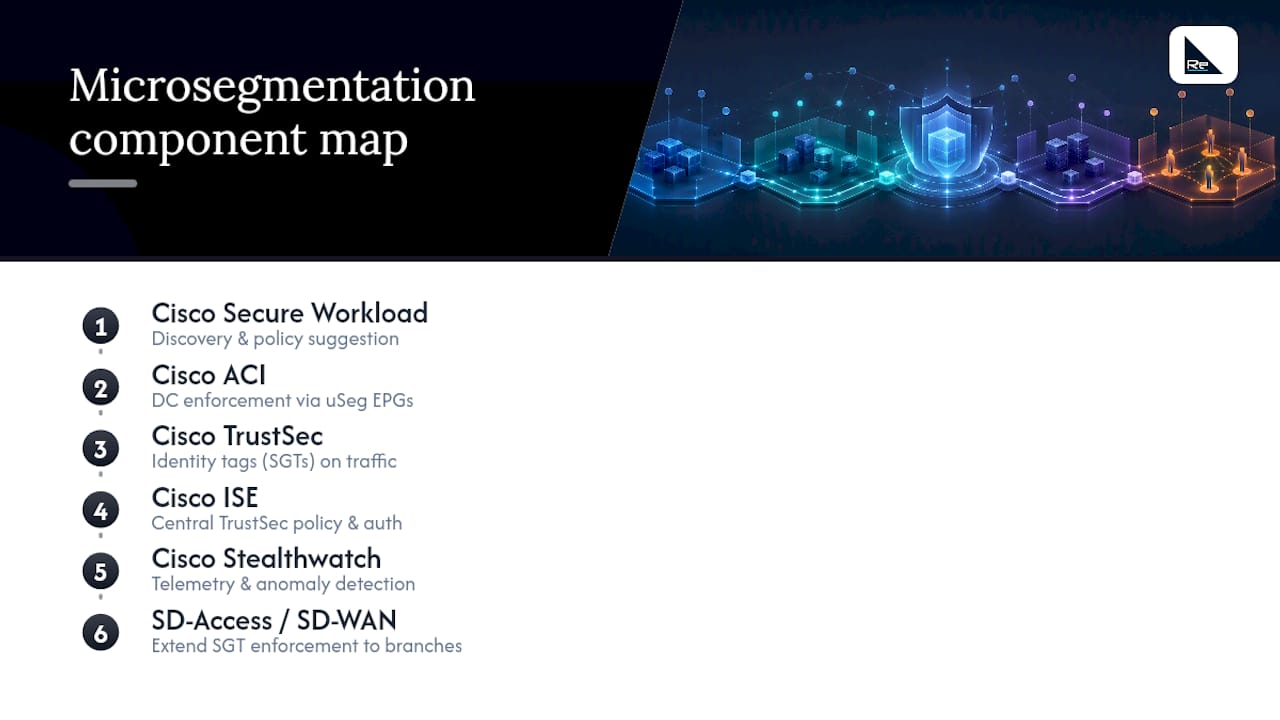
Cisco Secure Workload (formerly Tetration) is the discovery and policy engine. It ingests telemetry from agents or the network fabric, uses machine learning to map application dependencies, and then suggests allow-list policies automatically rather than asking engineers to write them from scratch. It supports both agent-based enforcement on hosts and agentless enforcement through cloud-native controls, which matters for hybrid multicloud estates where you cannot install an agent everywhere.
Cisco ACI handles microsegmentation inside the data-centre fabric through uSeg EPGs (User Segments within Endpoint Groups). APIC, the ACI controller, dynamically assigns virtual machines to microsegments based on VM or network attributes, and it supports intra-EPG isolation so that even workloads in the same logical group cannot talk to each other by default. It works across VMware VDS, Hyper-V, and Nutanix AHV virtual machine managers.
Cisco TrustSec takes a different approach: identity over IP address. It tags traffic with Security Group Tags (SGTs) at the point of entry, so policy travels with the user or device rather than being tied to a subnet that might change tomorrow. This matters enormously for campus networks where DHCP reassigns addresses constantly.
Cisco Identity Services Engine (ISE) is where TrustSec policy actually gets managed. ISE acts as the central policy engine for software-defined segmentation, combining SGTs with 802.1X and RADIUS authentication to push consistent policy across the whole hybrid network without redesigning the underlying topology every time a rule changes.
Cisco Stealthwatch supplies the visibility layer underneath all of it. You cannot write sound microsegmentation policy blind, and Stealthwatch’s telemetry feeds into ISE and TrustSec to detect anomalies and contain threats quickly once policy is live.
SD-Access and SD-WAN extend the same enforcement logic beyond the data centre, applying SGT-based policy at the campus edge and across remote sites so branch traffic gets the same treatment as data-centre traffic.
Agent-based, agentless, or hybrid: which enforcement model fits?
Choosing an enforcement model is less about picking a favourite and more about matching the tool to what each workload actually allows you to install.
-
Agent-based enforcement installs a lightweight agent on the host, giving Secure Workload process-level visibility. It knows exactly which binary opened which connection, not just which IP address did. That granularity is invaluable for forensic investigations and for managed servers where you control the build. The cost is deployment overhead: every host needs an agent installed, maintained, and monitored.
-
Agentless enforcement works through the network fabric or cloud platform instead. ACI’s uSeg EPGs and cloud-native security groups fall into this camp, and they are the only realistic option for unmanaged devices, legacy systems that cannot run an agent, and cloud-native workloads that scale up and down in seconds.
-
Hybrid enforcement is what most enterprises land on. Cisco’s own guidance frames agent-based and agentless approaches as complementary rather than competing: use agents where process-level forensic visibility genuinely matters, and lean on agentless enforcement everywhere an agent cannot be deployed or is not worth the operational cost.
Before scaling either model, check SGT propagation capacity. SXP (SGT Exchange Protocol) carries tags between devices that cannot tag traffic inline, and it has real throughput limits. Verify that switching hardware supports inline tagging where possible, because relying on SXP everywhere in a large, multi-domain network introduces latency and occasional bottlenecks that only show up under load.
Pro Tip: Run a hardware capability audit before committing to a wall-to-wall SGT rollout. Nexus 9000 switches with inline tagging support avoid a lot of the SXP scaling headaches that hit networks relying purely on software propagation.
How do you implement microsegmentation step by step?
A phased rollout beats a big-bang cutover on every metric that matters: fewer outages, faster stakeholder buy-in, and a rollback path if something breaks. CISA’s guidance backs the same sequencing: start narrow, validate, then widen scope.
-
Prepare. Inventory the assets you plan to segment, choose one pilot application (something business-critical but well-understood beats something obscure), and confirm hardware and software compatibility across Nexus switching, APIC, and ISE before you touch a policy. Get sign-off from the application owner too. Nothing stalls a rollout faster than a security team enforcing a policy that breaks a workflow nobody warned the business about.
-
Discover. Deploy Secure Workload agents or agentless collectors against the pilot scope, pull NetFlow data through Stealthwatch, and pull identity context from ISE. If the pilot touches virtualised infrastructure, pull metadata from vCenter or Kubernetes to understand what is actually talking to what. This phase routinely surfaces traffic flows nobody documented, and that discovery is the whole point.
-
Author. Build allow-list policies mapped to SGTs or EPGs based on what discovery actually showed, not what the architecture diagram claims should be happening. Keep blast radius minimal: a pilot policy that only governs three services is easier to validate and roll back than one covering thirty. Document the intent behind every rule, because six months from now nobody will remember why a rule exists unless it is written down.
-
Simulate and test. Secure Workload supports a simulated enforcement mode that analyses real telemetry against draft policy without actually blocking anything. Watch the ratio of flows the policy would allow versus block. A policy that would block 40% of observed legitimate traffic is not ready for enforcement; it means discovery missed something. Refine and rerun until the blocked-traffic ratio only catches what you actually intended to stop.
-
Enforce. Roll enforcement out in stages, starting with the lowest-risk segment of the pilot and expanding gradually. Keep a rollback plan documented and tested, not just written down somewhere. Capture policy evidence as you go, since compliance auditors will want proof that the segmentation you claim exists actually maps to enforced, logged rules.
Pro Tip: Never flip a new policy from simulate to enforce on a Friday afternoon. Give yourself a full working week to watch for edge-case traffic that only appears during specific batch jobs or month-end processes.
How do you manage the policy lifecycle without creating sprawl?
Microsegmentation is not a project with an end date. It is an operational discipline, and the policies you author in month one will be wrong by month six unless something keeps them current.
Automation should sit inside the lifecycle from day one, not get bolted on later. Treat policy changes the way you would treat application code: version them, review them, and push them through a controlled pipeline rather than editing rules ad hoc in a console. Automated tagging, where new workloads inherit SGTs or EPG membership based on metadata rather than manual assignment, removes one of the biggest sources of drift.
A handful of metrics tell you whether the programme is healthy:
- Policy churn rate — how often rules change relative to how often applications actually change; high churn with static applications suggests policies were wrong to begin with.
- False positive rate — legitimate traffic getting blocked, which erodes trust in the whole programme faster than almost anything else.
- Blocked-versus-allowed ratio drift — a sudden shift often signals either an application change nobody flagged or a genuine security event.
- Rule count per application — climbing steadily without a corresponding change in application complexity is the earliest sign of sprawl.
Governance matters just as much as the technical tooling. Put policy changes through the same change-control process as any other production change, schedule periodic reviews (quarterly is reasonable for most estates), and require sign-off from both security and the application owner before enforcement changes go live.
The single most effective way to avoid policy sprawl is abstraction. Write rules against roles, groups, and tags rather than individual IP addresses or hostnames. A policy built around an SGT for “finance application tier” survives infrastructure changes; a policy hard-coded to specific IPs breaks the first time something gets re-platformed.
What telemetry and integrations does Cisco microsegmentation need?
Visibility has to come before enforcement, not after it. Cisco’s own segmentation and visibility guidance is explicit on this point: you cannot secure traffic patterns you have never actually observed, and skipping straight to enforcement is how pilots turn into outages.
Assembling that visibility means pulling from several telemetry sources at once:
- Host agents for process-level detail on managed servers.
- NetFlow and IPFIX exported from switches and routers for network-wide flow data.
- Cloud tags and metadata from AWS, Azure, or GCP for workloads that live outside your own data centre.
- vCenter and Kubernetes metadata to understand virtual machine and container relationships that pure network telemetry cannot show.
On the integration side, most enterprise deployments need cloud connectors to pull tag data from public cloud accounts, integration with Cisco FMC or another NGFW for perimeter enforcement points that complement workload-level policy, load balancer integrations so that policy accounts for traffic that gets redirected rather than routed directly, and SXP where SGT propagation needs to cross devices that cannot tag traffic inline.
Combining Stealthwatch telemetry with ISE and TrustSec is what turns raw flow data into policy that actually reflects reality, and it shortens the time between spotting an anomaly and containing it.
Before flipping enforcement on anywhere, check two things: that baseline traffic has been captured across a full business cycle (not just a quiet Tuesday), and that key indicators like unexpected east-west flows or unauthorised admin connections have already been reviewed and explained.
What are the prerequisites and supported platforms?
Get these confirmed before scheduling a pilot, not during it:
- Nexus 9000 series switches running in ACI mode, with APIC deployed and licensed for the fabric size in question.
- Supported VMMs for uSeg EPGs: VMware VDS, Hyper-V, or Nutanix AHV, matched to whichever hypervisor the estate actually runs.
- ISE configuration basics: defined SGT ranges that will not collide with an existing scheme, and 802.1X configured on access ports where identity-based tagging at the edge is required.
- Secure Workload agent or connector compatibility with the operating systems and cloud platforms in scope, checked against the current supported-platform list rather than assumed.
- Licensing alignment across Secure Workload, ACI, and ISE, since gaps here are the most common reason pilots stall mid-project.
A quick readiness check before kicking off: confirm switching hardware supports inline SGT tagging, confirm ISE has spare policy capacity for the pilot’s SGT count, and confirm the pilot application owner has signed off on a defined test window.
What has Re-solution learned deploying this in the field?
Re-solution favours a visibility-first pilot for a straightforward reason: a policy authored without proper discovery generates false positives that erode trust in the entire programme within weeks. The pilot applications that pay back fastest tend to be well-understood, business-critical systems with a manageable number of dependencies, rather than the sprawling legacy applications everyone assumes need segmenting most urgently.
Two operational issues come up repeatedly. SGT propagation across older switching hardware that lacks inline tagging support forces reliance on SXP, which strains under scale; auditing hardware capability before committing to an SGT scheme avoids the problem entirely. Simulated-mode results also surprise teams more often than expected, usually because discovery ran during an atypical week and missed a monthly batch process that only fires once a cycle.
Before any enforcement goes live, Re-solution runs through a short readiness checklist: full-cycle traffic baseline captured, stakeholder sign-off documented, rollback plan tested rather than just written, and compliance evidence mapped to each policy. Readers can see how this plays out in practice in a Cisco ISE compliance case study covering a real engineering-sector deployment.
Is a Cisco-first approach always the right call?
Cisco’s microsegmentation stack earns its reputation because the pieces are designed to talk to each other. Secure Workload, ACI, TrustSec, and ISE share telemetry and policy context in a way that bolting together point products from different vendors rarely achieves without significant integration work. For any organisation already running Cisco switching and security infrastructure, extending that estate into microsegmentation is usually the path of least resistance and the lowest integration risk.
Where I’d push back on the conventional pitch is the assumption that more granularity is automatically better. Plenty of teams over-segment early, chasing a theoretical ideal of per-workload isolation before they’ve even finished mapping their own traffic. That produces policy sprawl faster than it produces security benefit. A Cisco-first approach makes the most sense when the estate already runs Cisco infrastructure and the team has the discipline to pilot narrowly first; it makes less sense as a reason to rip out working controls elsewhere purely for platform uniformity.
— Jacob
How Re-solution supports your microsegmentation rollout
The company has extensive experience delivering network infrastructure projects, and microsegmentation rollouts are part of their service offerings rather than a bolt-on service. The practical advantage for readers weighing this up is straightforward: instead of assembling Secure Workload, ACI, and ISE expertise across separate vendors or contractors, you get one partner who has already run the discovery-to-enforcement sequence in live enterprise environments.

A network audit is the natural starting point if you are still at the discovery stage, giving you a documented baseline before anyone commits to a pilot application. For organisations that want ongoing policy maintenance handled rather than absorbed into an already stretched internal team, managed IT services covers exactly that operational lifecycle, and Network as a Service offers a subscription route for teams that want the infrastructure delivered and kept current without a large upfront capital project. Get in touch to scope a readiness audit or pilot engagement against your own Cisco estate.
Sources
- Microsegmentation: zero-trust workload security Explained – Cisco
- The Journey to Zero Trust: Microsegmentation in Zero Trust Part One: Introduction and Planning – CISA
FAQ
What is the difference between a firewall and microsegmentation?
A firewall controls traffic crossing a defined boundary, typically between zones or at the network perimeter. Microsegmentation controls traffic between individual workloads inside those zones, closing off the lateral movement a firewall alone cannot see.
What is the difference between segmentation and microsegmentation?
Segmentation (or macrosegmentation) divides a network into broad zones using VLANs or VRFs, while microsegmentation applies policy at the individual workload level, governing exactly which workloads can communicate rather than which zones can.
How do you implement microsegmentation with Cisco tools?
Start with visibility using Secure Workload and Stealthwatch to map traffic and dependencies, pilot on one critical application, author allow-list policies mapped to SGTs or EPGs, validate them in simulated enforcement mode, then enforce in stages.
Does microsegmentation slow down network performance?
Well-designed policies add minimal latency because enforcement typically happens at the workload or fabric level rather than through additional hops. Performance issues usually trace back to SXP propagation overload on hardware lacking inline tagging support, not to microsegmentation itself.
Can Cisco microsegmentation help with regulatory compliance?
Yes. Policies mapped to specific applications and data flows give auditors a far clearer trail than shared VLANs ever could, and Re-solution’s PCI network segmentation guidance covers how this evidence holds up under assessor scrutiny.
Recommended
- Cisco Zero Trust Solutions & Services in UK
- Standards backed zero trust network access for IT leaders: 5 steps
- The Crucial Role of Zero Trust Security
- Modern network security: A complete guide for IT leaders