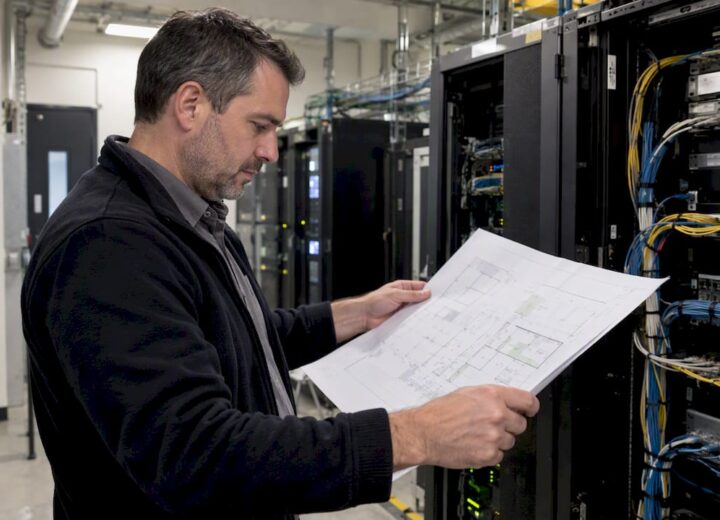
Building network commissioning is the structured process of verifying that a building’s network infrastructure, cabling, active equipment, wireless and integrated systems, meets the Owner’s Project Requirements before handover and throughout occupancy. The first action on any project is to record or confirm the OPR and appoint a commissioning lead or agent, then schedule an early design review. From that point, CIBSE, BCxA and relevant EN or DIN cabling standards should guide every subsequent decision.
TL;DR:
- Network commissioning should start in pre-design with clear owner requirements and continue through occupancy, updating the OPR continuously to avoid costly rework.
- Acceptance testing requires detailed evidence, including cable certification, configuration exports, and signed test logs, with failures documented and remediated promptly.
- Security measures like default credential removal, firmware logging, and system segmentation should be completed before handover to prevent operational vulnerabilities.
- Proper documentation, such as as-built diagrams, configuration backups, and test certificates, is essential for long-term maintenance and troubleshooting.
- Project delays often stem from late firmware updates, incomplete documentation, and scope disputes, all of which can be minimized by early agreement on the commissioning plan and criteria.
Table of Contents
- Phases of building network commissioning from pre-design to occupancy
- Roles and responsibilities: commissioning agent, contractors, IT and facilities
- Defining scope and success criteria: drafting the OPR and Commissioning Plan for networks
- Installation acceptance tests and functional testing: stepwise procedures and evidence to collect
- Cybersecurity, access control and firmware management during commissioning
- Documentation, handover and operational readiness: the artefacts operations must receive
- Timing, resourcing and typical effort: realistic durations and cost drivers
- Practitioner insight and Re-Solution experience: audits, surveys and handover best practice
- Why proper commissioning pays for itself over a building’s life
- How Re-Solution supports commissioning outcomes
- Sources
- FAQ
Phases of building network commissioning from pre-design to occupancy
Commissioning is not a single event at the end of a project. It runs through five distinct phases, and skipping any one of them tends to surface as unplanned cost later.
- Pre-design. The team establishes the Owner’s Project Requirements, assigns commissioning roles and confirms the scope of network systems, including wired, wireless, and building automation touchpoints.
- Design. Design reviews check that security requirements, integration points and future capacity are built into the network architecture rather than added afterwards.
- Construction. Installation verification and cabling acceptance tests confirm that what was specified is what got installed.
- Acceptance. Functional testing, remediation cycles and evidence capture confirm the network performs as required under real conditions.
- Occupancy and ongoing commissioning (OCx). Monitoring, trending and periodic re-testing keep the network aligned with the OPR as usage patterns change.
The pre-design phase sets the tone for everything that follows. BCxA’s new construction best practice describes commissioning (NCCx) as a process that begins in pre-design and continues through occupancy, with the OPR updated throughout the project rather than fixed once and forgotten. For network systems specifically, this means capturing bandwidth expectations, device density, wireless coverage requirements and any smart building integrations before a single cable is pulled.
Design-phase reviews are where most avoidable rework gets prevented. A network architecture that has not been checked against the OPR for segmentation, redundancy and integration with building management systems (BMS) tends to need retrofitting once occupants arrive and start reporting problems. Our step-by-step planning guide sets out the early-stage questions worth answering before design sign-off.
Construction-phase verification is largely physical: checking that cable routes match drawings, that containment is correctly sized, and that cabling has been tested and certified against the relevant EN or DIN standard for the cable category installed. This is also the point at which labelling conventions should be enforced, because retrofitting labels after commissioning is expensive and error-prone.
Acceptance testing is where the network is exercised under conditions that resemble actual use. Any failures identified here go through a remediation cycle: fix, retest, document, and only then sign off.
Occupancy and ongoing commissioning is frequently the weakest link in practice. Once occupants move in, the network is subject to real load, real interference and real failure modes that a controlled acceptance test cannot fully replicate. Ongoing commissioning means trending performance data, re-testing wireless coverage periodically, and revisiting the OPR as the building’s use evolves, whether that is added IoT sensors, a change of tenant, or expanded device density. Our guide to monitoring network health covers the practical side of sustaining performance once the commissioning team has left site.
Roles and responsibilities: commissioning agent, contractors, IT and facilities
Commissioning failures are rarely technical. They are usually the result of unclear ownership, where nobody was accountable for a specific artefact or decision and it fell through the gap between construction and operations.
- Commissioning agent: owns the Commissioning Plan, witnesses acceptance tests, and confirms that results meet the agreed pass or fail criteria before sign-off.
- Network contractor: supplies test data, configuration files, cabling records and remediation support when a test fails.
- Facilities or operations team: receives the O&M manuals, completes training, and formally accepts long-term operational responsibility for the network.
- Project manager or client representative: confirms that the OPR has been met and authorises final handover.
BCxA’s new construction best practice guidance frames the commissioning agent as the bridge between construction delivery and operational use, ensuring training and O&M documentation actually reach the people who will run the building day to day, rather than being filed and forgotten. Without that bridge, even a technically sound network can fail operationally because nobody on the facilities side knows how to interpret its configuration or respond to an alert.
A simple RACI structure keeps sign-off checkpoints unambiguous. The commissioning agent is typically Accountable for test witnessing and final sign-off; the network contractor is Responsible for delivering test evidence; IT or facilities is Consulted during acceptance criteria drafting and Informed at each sign-off checkpoint. Property developers and multi-site operators benefit particularly from this clarity, since responsibility for network performance often shifts between construction contractors and in-house or managed IT teams at handover, and an unclear boundary here is where warranty disputes tend to start.
Pro Tip: Name the commissioning agent in the contract documents before construction starts, not at handover, so acceptance criteria are agreed while there is still time to influence design.
Defining scope and success criteria: drafting the OPR and Commissioning Plan for networks
An OPR that says “the network should be fast and reliable” is not testable. Every requirement needs a measurable threshold, because commissioning can only confirm what has been defined precisely enough to fail.
For network systems, the OPR should specify:
- Availability targets, for example uptime expectations for core switching and wireless infrastructure.
- Latency and throughput thresholds appropriate to the building’s use, such as voice, video conferencing or industrial control traffic.
- Integration points, listing every system the network must connect to, including BMS, access control, CCTV and IoT platforms.
- Security baselines, covering segmentation requirements, authentication methods and minimum firmware versions.
- Capacity and density, stating expected device counts per zone and growth allowance.
Once these are defined, the Commissioning Plan translates them into pass or fail criteria and a testing regime. A latency threshold of, say, 20 milliseconds for voice traffic either passes or fails on measurement: there is no ambiguity to argue over on site. Life-safety and BMS-integrated circuits generally warrant full testing, while low-risk data outlets in identical, repeated office layouts can reasonably be sampled, provided the sampling method and rate are agreed and documented in advance rather than improvised during testing.
The Commissioning Plan itself should include checklist items covering:
- IP addressing and VLAN scheme, confirming allocation matches the design intent and leaves room for growth.
- Quality of Service (QoS) configuration, verified against the traffic types the OPR identifies as priority.
- Power over Ethernet (PoE) budgets, checked against actual connected device draw, not just switch port capacity.
- Time synchronisation, confirming NTP sources are correctly configured across network and integrated building systems.
- Redundancy and failover, tested under simulated failure rather than assumed from the design diagram.
Institutional commissioning specifications provide a useful template for this kind of clause writing. Lancaster University’s commissioning specification for network systems sets out sample clauses for cabling testing, labelling and documentation that project teams can adapt directly into their own Commissioning Plan, along with a practical expectation that straightforward data network connectivity is commissioned within five working days of building handover. That timeline is a useful anchor for simple activations, though integrated systems with BMS or IoT dependencies typically need longer.
Installation acceptance tests and functional testing: stepwise procedures and evidence to collect
Acceptance testing is where claims on a drawing get checked against reality. A structured sequence, moving from physical layer to application layer, catches problems before they reach occupants.
- Cable testing and certification. Every permanent link should be tested for wiremap, insertion loss and, where the cabling category requires it, near-end crosstalk (NEXT), with results certified against the relevant standard for that cable class.
- Active equipment verification. Confirm port configurations match the design, run PoE load tests against actual device draw, and verify redundancy by physically failing over a link or power path rather than trusting the topology diagram.
- Performance testing. Measure latency, packet loss and throughput under load, and check QoS marking and prioritisation actually take effect for voice and video traffic rather than just being configured.
- Integration functional tests. Confirm BMS connectivity, verify IoT device behaviour under normal and edge conditions, and check NTP accuracy across all connected systems, since time drift causes hard-to-diagnose logging and access control faults later.
- Evidence capture. Every test above should produce a retained artefact: test logs, screenshots, packet capture (pcap) extracts where relevant, and signed test sheets.
Wireless performance deserves its own attention within this sequence. A predictive design survey tells you where access points should go; a post-installation survey tells you whether they actually deliver coverage once furniture, occupants and RF interference are accounted for. Our wireless survey service is built around exactly this gap between design intent and as-built performance.
Functional performance testing during commissioning creates the baseline used for future benchmarking, according to BCxA’s new construction best practice guidance, which means the numbers captured during acceptance are not just a pass or fail gate. They become the reference point ongoing commissioning uses to detect drift months or years later.
Evidence discipline matters as much as the tests themselves. A test that passed but left no signed record is, for audit and warranty purposes, indistinguishable from a test that was never run. The minimum evidence set to retain includes:
- Signed and dated cable certification reports for every tested link.
- Configuration exports for switches, wireless controllers and any integrated gateways at the point of acceptance.
- Screenshots or exported logs from performance test tools showing latency, jitter and throughput results.
- Packet captures for any integration point where functional behaviour, rather than just connectivity, was in question.
- A signed acceptance form referencing the specific pass or fail criteria from the Commissioning Plan.
Our network infrastructure checklist sets out a fuller sequence for formal acceptance testing, covering cabling, active equipment and connectivity checks in a format suitable for use directly on site.
Failures at this stage are normal and expected, not a sign the project has gone wrong. What distinguishes a well-run acceptance phase is how quickly a failure is diagnosed, remediated and retested, with each cycle documented rather than quietly resolved off the record. A remediation log that shows three attempts before a link passed certification is more useful to future troubleshooting than a record that only shows the final pass.

Cybersecurity, access control and firmware management during commissioning
Commissioning is the last point at which the network’s security posture is fully within the project team’s control, before day-to-day operational pressures make changes harder to push through. Getting the baseline right here saves considerably more effort than fixing it after occupancy.
- Remove or replace all default credentials on switches, wireless controllers, access points and integrated gateways before handover, and document any temporary accounts used during commissioning so they can be closed out.
- Maintain an auditable firmware and patch log, recording the version and update date for every piece of active equipment, so operations staff inherit a known baseline rather than a mystery.
- Segment building systems and IoT devices away from general data traffic, applying access control appropriate to each system’s risk, since a compromised IoT sensor should never have a path to core infrastructure.
- Run lightweight security checks before sign-off, including a review of open management ports, default SNMP strings, and unused services on active equipment.
Segmentation decisions made during commissioning tend to be far cheaper than the same decisions made after occupants, contractors and integrated systems are all live and dependent on the existing VLAN structure. A building automation system that was never separated from the general network at commissioning is a difficult and disruptive thing to re-segment eighteen months later.
Pro Tip: Record every temporary credential and account created during commissioning in the same log used for firmware versions, and close them out as a discrete line item on the final acceptance form, not as a verbal handover note.
Security checks at handover do not need to be exhaustive to be useful. Confirming that management interfaces are not exposed to guest or public-facing networks, that default community strings have been changed, and that firmware versions are current at the point of handover covers the most common causes of early-life compromise. Recording these results alongside the other test evidence means operations staff are not starting from zero if a security review is requested later. Our guide on network security posture covers the ongoing side of this once commissioning is complete.
Documentation, handover and operational readiness: the artefacts operations must receive
A network that passes every test but hands over no usable documentation has not really been commissioned. It has been tested once and left to the operations team to reverse-engineer.
The handover package should include:
- As-built network topology diagrams and IP addressing plan, reflecting what was actually installed, not the original design intent.
- Configuration backups and change logs, capturing every device configuration as deployed, plus a record of any changes made during commissioning.
- Firmware and patch logs, listing the version and update date for every active device, matching the log kept during the security checks above.
- Test certificates and calibration records, including cable certification reports and any test equipment calibration references.
- Final acceptance forms, signed against the pass or fail criteria set out in the Commissioning Plan.
- O&M manuals, written for the operations team’s actual skill level rather than assuming contractor-level familiarity.
- Escalation contacts, naming who to call for each system when something goes wrong after the contractor has left site.
- Training completion records, confirming which facilities staff attended handover training and on what date.
Handover quality is frequently the difference between a network that stays healthy for years and one that accumulates undocumented changes until nobody can safely troubleshoot it. Finalised configuration files, firmware logs and accurate as-built diagrams are the artefacts that make long-term operation possible, and they should be specified explicitly in the Commissioning Plan rather than left to whatever the contractor happens to produce.
Property developers and multi-site operators handing a building to a third-party operations team have a particular stake in getting this right, since the people running the network long-term may never have met the installing contractor. A complete, well-organised handover package is what lets that operations team troubleshoot a fault at 2am without needing to phone anyone.
Timing, resourcing and typical effort: realistic durations and cost drivers
Commissioning timelines vary considerably with project scale, but a few patterns hold across most building types.
Simple network activations, such as connecting an already-cabled and tested space to existing infrastructure, tend to be quick. Institutional commissioning specifications note that straightforward data network connectivity is commonly commissioned within a few working days of building handover, according to Lancaster University’s network commissioning specification, a useful benchmark for single-building, low-complexity activations. Multi-system integrations involving BMS, access control and IoT, however, typically need considerably longer, since each integration point requires its own functional test cycle and remediation window.
Sampling strategies reduce cost by testing a representative subset of links or devices rather than every single one, but they carry a real risk: a fault in an untested link stays hidden until it fails in operation, often at a worse time than during commissioning. Full testing is generally justified for life-safety circuits, BMS-integrated points and any system where a fault would be expensive or dangerous to diagnose retrospectively.
Common causes of delay include:
- Late firmware availability, where equipment ships with a version that does not yet support a required feature.
- Missing or incomplete documentation from earlier project stages, forcing the commissioning team to reverse-engineer design intent.
- Contractor rework, where a failed acceptance test triggers a remediation cycle that was not accounted for in the schedule.
- Unclear acceptance criteria, leading to disputes over whether a borderline result counts as a pass.
The most reliable mitigation for all of these is the same: agree the OPR and Commissioning Plan early enough that firmware, documentation and acceptance criteria are settled well before the acceptance testing window opens.
Practitioner insight and Re-Solution experience: audits, surveys and handover best practice
A commissioning agent’s real value is rarely in running the tests themselves. It is in acting as the fixed point of accountability between a construction team that moves on once handover is signed and an operations team that has to live with the result for years. BCxA’s best practice guidance describes this bridging role explicitly, noting that commissioning outcomes improve when the agent ensures training and O&M manuals actually reach the people who will operate the building, rather than treating documentation as a formality to satisfy at sign-off.
Audit and commissioning engagements typically produce a defined set of deliverables that map onto this bridging role:
- A documented audit scope, setting out exactly which systems, links and integration points were assessed.
- A corrective action list, prioritised by risk, covering every finding that fell short of the agreed criteria.
- Verification evidence, tying each corrective action to a retest result rather than a verbal confirmation that it was fixed.
- A handover-ready summary, translating technical findings into language the operations team can act on without contractor support.
For an operations team receiving a newly commissioned network, a short list of immediate priorities keeps the first weeks manageable: confirm all documentation matches the as-built network, test the escalation contacts actually respond, verify that monitoring and alerting are active from day one, and schedule the first re-test date for wireless coverage or performance baselines rather than waiting for something to go wrong. Our network audit checklist sets out a fuller version of this for teams that want a structured starting point.
Why proper commissioning pays for itself over a building’s life
Commissioning is often treated as a formality to clear before a building opens, but the technical detail in this guide points to a different conclusion: it is one of the more reliable levers available for controlling lifecycle cost. A network that is properly tested, documented and handed over with clear ownership tends to generate far fewer emergency call-outs, because faults get caught while a contractor is still on site and accountable, not months later when nobody can say whether a fault is new or has always been there.
The gap most projects underestimate is not testing effort, it is documentation discipline. Teams will happily run every test on the checklist and then hand over a folder of disconnected PDFs with no as-built diagram to tie them together. That gap is where operational cost actually accumulates, in the hours an operations team spends reverse-engineering a network nobody wrote down properly.
— Jacob
How Re-Solution supports commissioning outcomes
Getting from a signed Commissioning Plan to a fully accepted network is easier with an independent set of eyes on the acceptance evidence. Re-Solution’s network audit service reviews commissioning documentation and test results against the original OPR, flagging gaps before they become warranty disputes, while wireless surveys confirm as-built coverage against the design intent rather than assuming the predictive model held true on site.
Beyond the commissioning window itself, Managed Services and Network As A Service give operations teams ongoing support for the monitoring, trending and periodic re-testing that occupancy-phase commissioning requires, without needing to build that capability in-house. Experience in Cisco-focused infrastructure supports sectors such as education, manufacturing, logistics, hospitality and property development in handover and ongoing commissioning support.
- Network Audits: independent verification of commissioning evidence and remediation planning.
- Wireless Surveys: as-built coverage confirmation against design and OPR targets.
- Managed Services: ongoing operational support after handover.
- Network As A Service: subscription-based network delivery for teams that prefer a managed model post-commissioning.
Get in touch through our services overview to discuss commissioning support for your next project.
Sources
For teams drafting their own Commissioning Plan, three documents are worth reading in full rather than relying on summaries. CIBSE’s Commissioning Code A covers air distribution commissioning and is intended to be read alongside CIBSE’s other commissioning codes for a full building systems view. BCxA’s new construction best practice guidance sets out the full NCCx process from pre-design through ongoing commissioning. Lancaster University’s network commissioning specification offers real clause wording for cabling, testing and documentation requirements that can be adapted directly into a project contract.
- BCxA – New construction building commissioning best practice v3
- Lancaster University – Commissioning specifications for new buildings or major refurbishments (network)
FAQ
What are the 8 stages of commissioning?
Different frameworks split commissioning into varying numbers of stages, but most extend the five broad phases in this guide, pre-design, design, construction, acceptance and occupancy, into finer steps such as design review, installation verification, functional performance testing, training, and ongoing commissioning. Definitions vary between standards bodies, so it is worth confirming which framework a specific project or contract references before assuming a fixed eight-step model applies.
What does “building commissioning” mean?
Building commissioning is the process of verifying that a building’s systems, including networks, BMS, HVAC and electrical infrastructure, are installed, tested and documented to meet the Owner’s Project Requirements before and after handover. It combines design reviews, functional testing and documentation handover to confirm that what was built actually performs as intended.
What are the three main types of commissioning?
Commissioning is commonly grouped into new construction commissioning, retro-commissioning for existing buildings that were never formally commissioned, and ongoing commissioning (OCx), which covers the monitoring and periodic re-testing that continues throughout occupancy. BCxA’s best practice guidance recommends incorporating ongoing commissioning into new construction projects from the outset rather than treating it as a separate later exercise.
What are the five levels of commissioning?
There is no single universally agreed “five levels” framework across commissioning standards bodies, and definitions vary by industry and standard. The five phases most consistently referenced in practice are pre-design, design, construction, acceptance and occupancy or ongoing commissioning, each covered in detail earlier in this guide.
How long does building network commissioning typically take?
Simple network activations can be commissioned quickly, with one institutional specification noting that straightforward data connectivity is commonly commissioned within five working days of handover. Projects involving BMS, access control or IoT integration generally take considerably longer, since each integration point needs its own functional test and remediation cycle.
Recommended
- Connectivity planning for new builds: a developer’s guide
- The role of networking in smart buildings
- How to upgrade building network infrastructure
- How to design digital building infrastructure