Managed SD-WAN typically costs a varying amount per site each month, often depending on bandwidth, hardware amortisation and security features, with most European deployments landing in the mid-hundreds once transport, bandwidth, hardware amortisation and security features are factored in. Transport (the underlying circuit) and the licence or service tier drive most of that variation, not the SD-WAN overlay itself. The single most useful thing you can do before signing anything is ask every vendor to itemise their quote so transport and overlay costs sit in separate lines, not one blended figure.
TL;DR:
- Transport costs, such as dedicated internet access and MPLS, usually dominate SD-WAN expenses, especially at scale, so prioritize negotiating circuit prices first.
- Vendor quotes are most accurate and comparable when transport, licence, hardware, and support are itemized separately, allowing independent cost comparisons.
- Multi-site deployments benefit from volume discounts and longer contract commitments, which can significantly reduce per-site costs but may lock in transport assumptions.
- The biggest savings compared to MPLS come from replacing expensive circuits, with potential reductions of 20 to 50 percent depending on initial infrastructure costs.
- Self-managed SD-WAN requires in-house expertise, while Managed Network as a Service simplifies budgeting by consolidating costs and ongoing support into a single relationship.
Table of Contents
- What drives SD-WAN pricing at each site?
- Which SD-WAN pricing model applies to your quote?
- How much should you budget for 3, 25, or 100 sites?
- Does SD-WAN actually cost less than MPLS?
- What should you ask vendors before comparing quotes?
- Managed NaaS or self-managed SD-WAN: which suits your budget?
- Editorial take: what most SD-WAN budgeting advice gets backwards
- Get a componentised SD-WAN quote from Re-solution
- Sources
- FAQ
What drives SD-WAN pricing at each site?
SD-WAN pricing is rarely one number. It’s a stack of separately priced components, and understanding each one is what separates a defensible budget from a guess.
Transport (the underlay). This is the physical circuit carrying your traffic: dedicated internet access (DIA), business broadband, residual MPLS links, or 4G/5G as primary or backup. Transport cost varies enormously by location and bandwidth, and it usually dictates the SLA you get. A DIA circuit typically carries firmer latency and uptime guarantees than a broadband line, and that reliability shows up directly in the invoice.
Hardware (CPE). SD-WAN appliances range from small branch devices to enterprise-grade edge routers. Many providers now roll hardware into a subscription rather than charging upfront capital expenditure, but if you’re buying outright, expect to amortise the device cost over three to five years when calculating true monthly spend.
Software licensing and feature tiers. Licences are usually sold per site or per device, with pricing stepped by feature tier, entry-level SD-WAN routing versus advanced application-aware steering, for instance. This is where costs often creep: overlapping licence types purchased for different platforms can duplicate functionality without anyone noticing until renewal.
Professional services and installation. Site surveys, configuration, staging and cutover are typically billed as one-off, non-recurring charges. These are easy to underestimate in a multi-site rollout because they scale with site count, not just complexity.
Ongoing operational spend. Monitoring, patching, change management and a managed service wrap all add recurring Opex. Whether you handle this internally or outsource it changes the shape of your budget more than almost any other decision.
Optional add-ons. High availability (dual circuits or dual appliances), LTE failover, WAN optimisation and SASE-style security bundles all raise the recurring bill, sometimes substantially.
- Transport: DIA, broadband, MPLS legacy circuits, 4G/5G backup
- Hardware: CPE purchase or subscription, refresh cycle every 3 to 5 years
- Licensing: per-site or per-device, tiered by feature set
- Professional services: survey, install, cutover (one-off)
- Operations: monitoring, patching, managed service fees
- Add-ons: HA, LTE failover, WAN optimisation, SASE security
Benchmark data from ACG Research shows something counter-intuitive: buyers tend to fixate on the per-device licence line, but underlay circuit costs are usually the bigger factor once you aggregate bandwidth across a multi-site estate. Chase the transport spend first, not the SD-WAN licence.
Which SD-WAN pricing model applies to your quote?
Vendors structure their pricing in a handful of recognisable ways, and knowing which one you’re looking at is the difference between comparing quotes properly and comparing apples to spreadsheets.
- Per-site subscription (all-inclusive). One fee covers hardware, licence, transport and support. It’s predictable and easy to budget, but it can bury the actual transport cost inside the bundle, making it hard to spot if you’re overpaying for a circuit.
- Overlay and transport unbundled. The SD-WAN service fee is separate from the circuit charge. It takes more work to assemble, but it’s the only structure that lets you shop transport independently and compare underlay pricing across carriers, which ACG Research confirms is how most enterprise pricing is genuinely built.
- Bandwidth-based pricing. You pay by Mbps consumed or committed. This rewards steady, high-throughput sites but penalises locations with bursty, unpredictable traffic patterns, where a flat-fee model may work out cheaper.
- Feature tiers and security bundles. Basic routing sits at the bottom; SASE-style security (secure web gateway, cloud firewall, ZTNA) sits at the top and adds meaningfully to the recurring bill. VendorBenchmark notes that at higher bandwidth tiers, quoted prices between vendors can vary by 2 to 3 times, largely because of what’s bundled into the “premium” tier.
- Pay-as-you-go or metered options. Useful for temporary sites, seasonal locations, or pilot rollouts, but rarely the cheapest route for a permanent, stable estate.
- Contract length and volume. Multi-year commitments and higher site counts routinely unlock discounts of 10 to 20% versus month-to-month or single-site pricing, though that varies by vendor and negotiation position.
How much should you budget for 3, 25, or 100 sites?
A workable formula for estimating total monthly cost per site looks like this:
Transport + SD-WAN service fee + hardware amortisation + implementation (spread over contract term) + ongoing support = total monthly cost per site.
Applying that across three estate sizes shows how the maths shifts with scale.
- Scenario A, three sites (small estate). Assume a mid-tier managed service with DIA at each location: roughly $250 to $400 per site per month covering transport, overlay licence and basic support, plus a one-off installation charge per site. Annual cost across three sites lands somewhere between $9,000 and $14,400, before installation.
- Scenario B, 25 sites (mid-size rollout). At this scale, bandwidth tiering starts to matter. A mix of standard broadband sites and a handful of higher-bandwidth locations might average $300 to $500 per site per month. Aggregated, that’s roughly $90,000 to $150,000 annually, and volume discounts on licensing typically begin to bite here, often shaving 10% or more off list pricing.
- Scenario C, 100 sites (large enterprise). Carrier committed-rate agreements and multi-year licence discounts change the economics substantially. Per-site costs can compress towards $220 to $380 per month at this volume, but the total exposure, potentially $260,000 to $460,000 a year, makes even small percentage errors in transport pricing expensive.
Sensitivity matters more than the headline number. Adding a SASE security bundle across the estate can add a similar amount again. Model these variables separately rather than accepting one blended “per site” figure from a vendor.
Does SD-WAN actually cost less than MPLS?
Often, yes, but not automatically, and the comparison lives or dies on how you separate overlay from underlay in your total cost of ownership (TCO) model.
Industry TCO analysis puts typical savings from switching MPLS capacity to SD-WAN with broadband or DIA transport at 20 to 50%, according to comparative research from Telecomate. That range is wide because the outcome depends heavily on your starting point: an estate already on expensive legacy MPLS circuits in remote locations sees the biggest gains, while sites with existing low-cost broadband see far less.
Where savings do not materialise:
- Sites where MPLS pricing was already competitive due to local carrier density
- Estates that retain MPLS as a backup path alongside new SD-WAN transport (you pay for both)
- Deployments where added security tiers or HA design offset transport savings
Build your TCO model around four inputs: hardware amortisation over its refresh cycle, staff time for management (internal or outsourced), transport price variance by site, and licence discounts tied to contract length. TeleGeography’s pricing benchmarking tools are useful here, letting you check transport pricing against carrier data by geography rather than relying on a single vendor’s assumptions.
What should you ask vendors before comparing quotes?
Comparable quotes don’t happen by accident. Vendors will format proposals however suits them unless you set the terms.
- Request componentised pricing. Ask for transport, overlay licence, hardware, installation and support to appear as separate line items, not a single monthly figure. Netify’s procurement guidance treats this as the single most effective tactic for avoiding misleading “all-in” numbers.
- Define SLA metrics precisely. Ask for packet loss, jitter, latency and time-to-repair thresholds in writing, and confirm what actually constitutes a breach and what remedy follows.
- Ask about lifecycle terms. Hardware refresh policy, software upgrade path, and what happens to your data and configuration if you leave.
- Push on commercial levers. Site count commitments, multi-year terms, staggered activation timing and bundling security services together can all shift pricing meaningfully.
- Watch for red flags. Auto-renewal clauses with short notice windows, vague SLA breach definitions, and hardware “ownership” that’s actually a lease disguised as a purchase.
Pro Tip: Run a pre-quote network survey before you approach vendors. A documented baseline of your current bandwidth, site count and traffic patterns stops every proposal from being built on the vendor’s assumptions instead of your actual estate.
Managed NaaS or self-managed SD-WAN: which suits your budget?
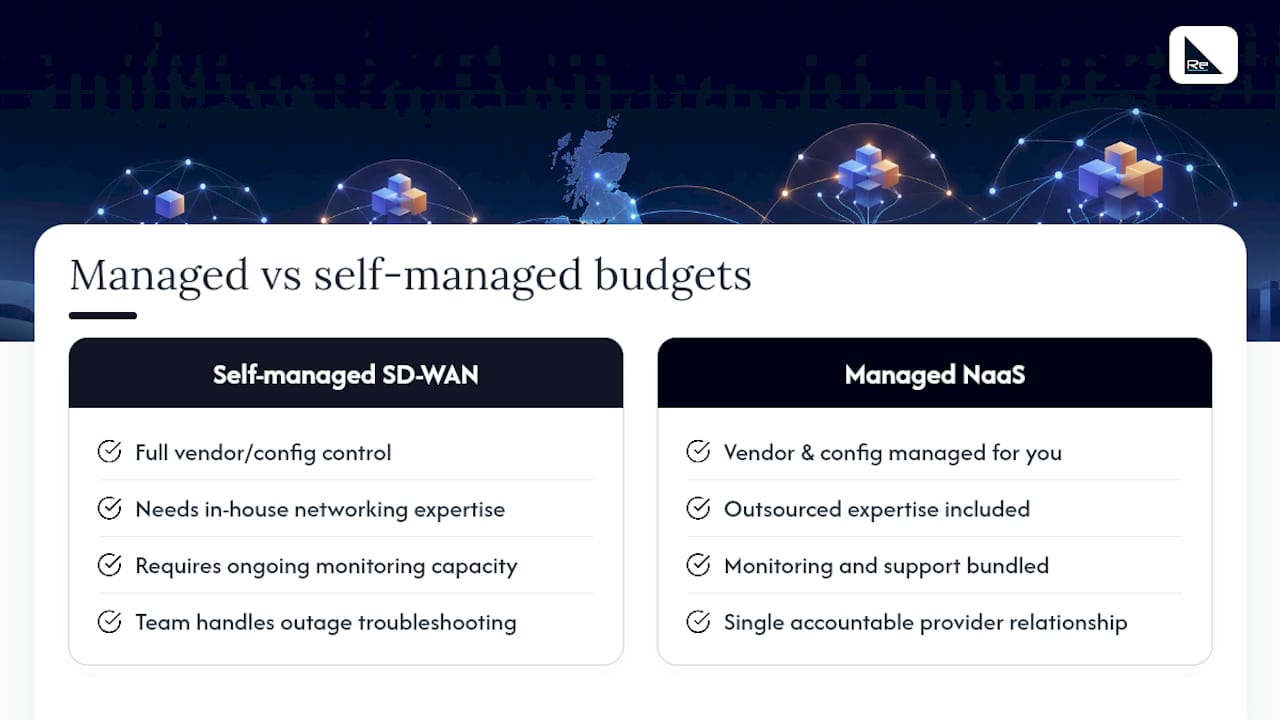
Self-managed SD-WAN gives you direct control over vendor selection and configuration, but it demands in-house networking expertise, ongoing monitoring capacity and the ability to absorb troubleshooting during outages. For lean IT teams, that staffing burden is often the real cost, one rarely captured in a per-site pricing table.
Managed Network as a Service folds transport, overlay, hardware and support into a single accountable relationship, which is precisely where the budgeting complexity described above gets absorbed rather than left for your team to untangle quote by quote. Re-solution has worked as a Cisco partner for more than 35 years, and its audits and network surveys are typically the first step towards a componentised quote, establishing current bandwidth use, site criticality and existing contract terms before any pricing conversation starts.
Editorial take: what most SD-WAN budgeting advice gets backwards
Most guidance on this topic obsesses over per-site licence comparisons, because that’s the number vendors put on the cover slide. The research tells a different story: transport aggregation across your estate usually moves the total bill more than any feature tier decision. If you only scrutinise one line item, make it the circuit cost, not the SD-WAN subscription fee.
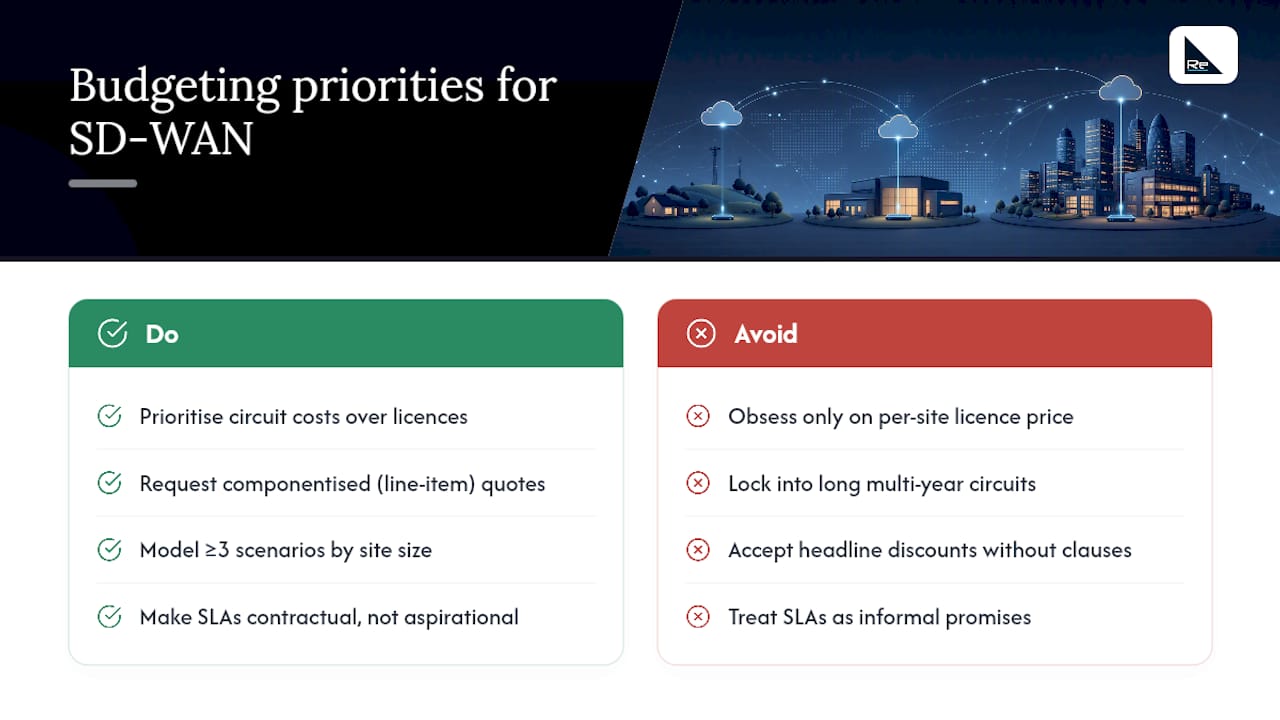
The other place conventional advice falls short is contract structure. Multi-year commitments look attractive on a discount sheet, but they lock in your transport assumptions for years in a market where circuit pricing shifts regionally and often. A shorter initial term with a clear activation and refresh clause is frequently worth more than a headline discount.
Prioritise componentised quotes over all-in numbers, model at least three scenarios matched to your actual site sizes, and treat SLA definitions as contractual, not aspirational. Everything else in a vendor’s pricing deck is negotiable detail sitting on top of those three decisions.
— Jacob
Get a componentised SD-WAN quote from Re-solution
A trusted Cisco partner builds quotes from a network survey first, separating transport, overlay licensing, hardware and support before a figure ever reaches you.

That matters because, as the pricing scenarios above show, blended “all-in” quotes are exactly where budgets go wrong. A managed Network as a Service engagement absorbs the monitoring, patching and lifecycle management that self-managed teams often underestimate, while keeping every cost component visible to you. If you’re weighing SD-WAN against your existing MPLS or broadband setup, start with a network audit to establish your baseline, then request a componentised quote through the Network as a Service team.
Sources
- SD‑WAN platform pricing benchmarks (VendorBenchmark)
- Get quotes to find out how much SD‑WAN costs — Netify
- SD‑WAN pricing data — TeleGeography
FAQ
How much does SD-WAN cost?
Managed SD-WAN typically ranges from around $180 to $1,500 per site each month, with European deployments commonly averaging in the mid-hundreds once transport, licensing and support are included.
How much does the SD-WAN exam cost?
Certification exam fees vary by vendor and region and aren’t part of service pricing; check the specific certifying body’s website for current exam costs, as this figure isn’t covered by the benchmarks used in this article.
Is SD-WAN obsolete?
No. SD-WAN remains the standard approach for combining multiple transport types under centralised policy control, and its adoption keeps growing alongside SASE and security bundling rather than being replaced by it.
How much does a WAN network cost?
Traditional WAN costs depend heavily on the transport type chosen, with MPLS circuits generally priced higher than broadband or DIA of equivalent bandwidth; TCO comparisons show SD-WAN based on broadband or DIA can cut overall WAN spend by 20 to 50% versus legacy MPLS, depending on your starting circuit prices.
Recommended
- SD-WAN for manufacturing: what network teams must do next
- IP connect for UK IT teams: what to choose
- SD-WAN failover design: a playbook for network architects
- Bandwidth management: optimise your network and boost productivity