Technology blocks are modular network, security, and connectivity components, such as core, access, wireless, SD‑WAN, NaaS and IoT modules, that IT teams combine to build enterprise and campus infrastructure without designing every system from scratch. The recommended approach for 2026 is straightforward: adopt these blocks against a validated orchestration and security baseline, then prove the design in a pilot before scaling.
That means specifying architectures aligned to established reference designs rather than bespoke builds. Three names anchor most credible deployments today:
- Cisco Catalyst SD‑WAN for the network overlay and control plane
- NVIDIA MGX for modular, rack‑scale compute
- UWB‑RTLS (ultra‑wideband real‑time locating systems) for facility‑level asset visibility
Get the block selection and security baseline right first. Everything else, timelines, budgets, vendor negotiations, follows from that decision.
Key Takeaways
Modular technology blocks succeed when procurement demands validated reference architectures and a four‑block security baseline before any pilot scales.
| Point | Details |
|---|---|
| Define the block catalogue | Scope core, access, wireless, SD‑WAN/NaaS, security and IoT modules before writing an RFP. |
| Demand all four security blocks | Require microsegmentation, SWG, IPS with threat intelligence and DNS‑layer security together, not piecemeal. |
| Insist on validated reference architectures | Ask vendors for proven builds like Cisco Catalyst SD‑WAN or NVIDIA MGX, not bespoke integration promises. |
| Pilot before scaling | Run a single‑site pilot with clear KPIs (MTTR, provisioning time) before committing capital to a wider rollout. |
| Start with an audit | Re‑solution’s infrastructure audits and NaaS model give a low‑risk entry point for specifying and delivering modular blocks. |
Table of Contents
- What are technology blocks in enterprise network design?
- What are the four security blocks every SD‑WAN needs?
- How do you architect technology blocks that integrate reliably?
- What should a technology block procurement checklist include?
- What does a phased technology block rollout look like?
- How does Re‑solution support technology block adoption?
- How do you future‑proof technology blocks as requirements evolve?
- How should you monitor and maintain technology blocks after deployment?
- What are the main risks when adopting technology blocks?
- Lessons from real modular deployments
- Getting your modular deployment off the ground with Re‑solution
- Sources
- FAQ
What are technology blocks in enterprise network design?
A technology block is a discrete, interoperable module you can specify, procure and replace independently of the rest of the network. Think of it as componentised infrastructure: you’re not designing a monolithic system, you’re assembling proven parts.
The standard catalogue for enterprise and campus environments includes:
- Core and fabric — the compute and switching backbone that everything else connects to
- Access switching — edge connectivity for devices, users and endpoints
- Wireless — Wi-Fi and increasingly private cellular for coverage
- WAN, SD‑WAN and NaaS — the connectivity layer linking sites, clouds and branches
- Security modules — purpose‑built blocks covering segmentation, inspection and threat detection
- IoT and smart‑building modules — sensors, controllers and RTLS feeds for connected facilities
- Compute racks with liquid cooling — high‑density blocks for AI workloads, where modular computing disaggregates compute, storage, accelerators and networking so resources are provisioned through software rather than fixed hardware
Digital Twin and BIM integrations sit alongside these as an enabling pattern rather than blocks in their own right: they give facilities teams a live model to test layout changes before committing capital. Note that this catalogue has nothing to do with consumer building‑block toys or novelty tech gadgets; it describes the componentised infrastructure that underpins smart building and campus network design.
What are the four security blocks every SD‑WAN needs?
Security cannot be an afterthought bolted onto a modular network once it’s live. Enterprise‑grade SD‑WAN security typically integrates four critical security blocks, and any RFP that doesn’t demand all four is incomplete:
- Microsegmentation — isolates workloads and users so a breach in one segment can’t traverse the network
- Secure web gateway (SWG) — inspects and filters outbound traffic before it reaches the internet
- Intrusion prevention system (IPS) with threat intelligence — detects and blocks known attack patterns in real time
- DNS‑layer security — stops malicious domains being resolved before a connection is even attempted
Enterprise firewalls, SSL/TLS decryption and SASE/SSE platforms typically wrap around these four blocks rather than replace them. For sectors with strict regulatory obligations, SD‑WAN overlays sometimes need dedicated cryptographic devices and GRE tunnels to satisfy encryption mandates that software‑only VPN tunnels don’t meet.
Pro Tip: During pilot testing, demand a live demonstration of policy enforcement across all four blocks simultaneously, not sequential vendor demos of each in isolation. A proof of concept for identity‑based policy will expose gaps that a slide deck never will.
How do you architect technology blocks that integrate reliably?
Three patterns dominate credible modular deployments. The first is disaggregated compute and fabric, where rack‑scale reference designs such as NVIDIA MGX allow factory pre‑integration of mechanical, electrical and plumbing components, cutting field assembly time for high‑density AI workloads considerably compared with bespoke rack builds.
The second is SD‑WAN overlay with a centralised control plane, exemplified by Cisco Catalyst SD‑WAN designs that separate the data plane from policy management so branches, clouds and data centres are governed from a single pane of glass.
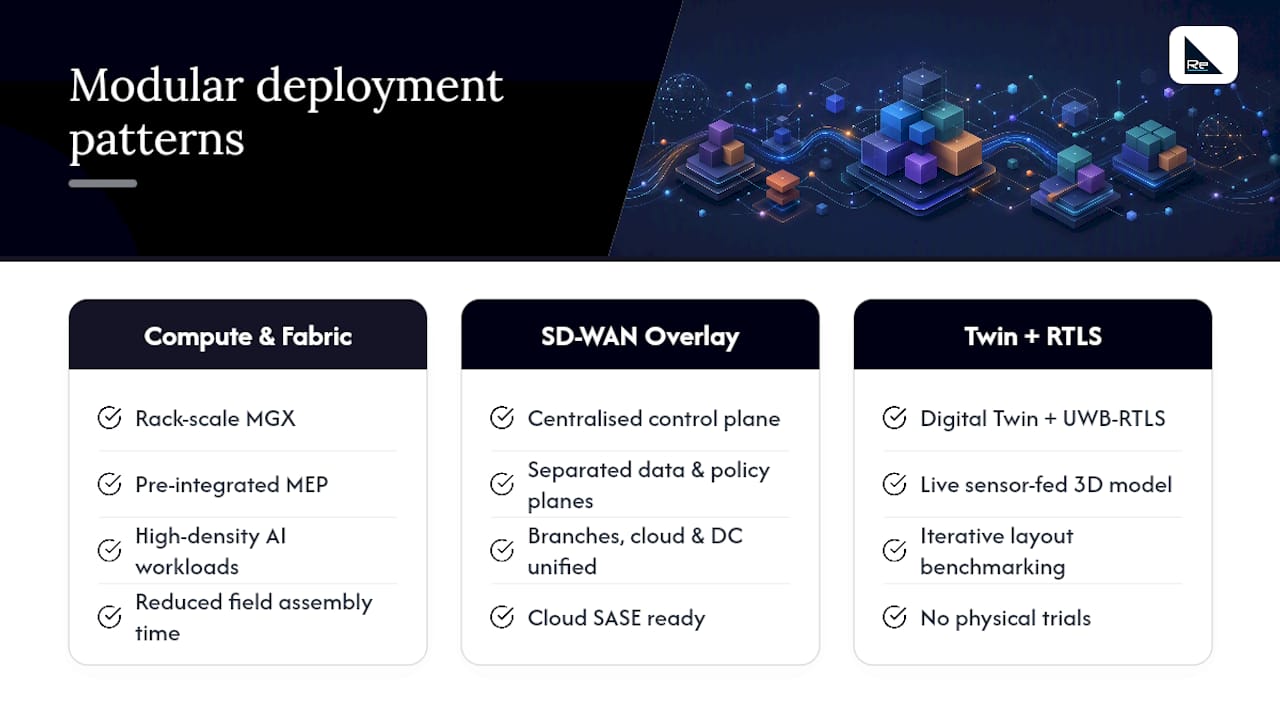
The third pattern, less discussed but increasingly relevant for property developers and manufacturing sites, combines Digital Twin models with RTLS feeds. The UTwente Learning Factory demonstrated this directly: UWB‑RTLS combined with 3D simulation kept a digital model updated from live sensor data, enabling iterative layout benchmarking without physical trial and error.

Orchestration is the connective tissue across all three. Whoever owns the policy plane needs one‑pane management, automation for repeatable provisioning, and SLAs written at the CxO level, not buried in a technical appendix nobody reads.
Pro Tip: Picture a reference architecture as: a pilot branch running SD‑WAN with cloud SASE, an on‑premises MGX‑style compute rack, and RTLS sensors feeding a Digital Twin. That four‑part sketch is enough to brief any vendor.
What should a technology block procurement checklist include?
Specification quality determines whether a modular deployment stays modular or quietly becomes another vendor‑locked monolith. Before issuing an RFP, confirm the following:
- Interoperability standards — CXL, NVLink, PCIe and COTS fabric standards for compute; open orchestration APIs for network and security
- Observability and telemetry — can every block report into a common monitoring stack, or does each need a separate console?
- Compliance and encryption options — including dedicated crypto devices where regulatory obligations demand them
- Power and cooling envelope — particularly for AI‑dense compute racks, where liquid cooling requirements shift facility planning
- SLAs and support model — response times, escalation paths and who owns the fix when a fault spans two vendors’ blocks
Once the checklist is satisfied, put these questions to every shortlisted vendor:
- Can you show a validated reference architecture, not just a diagram, for a deployment similar to ours?
- What percentage of the rack or block arrives factory pre‑integrated versus field‑assembled?
- What’s your software lifecycle policy, and how often do firmware and orchestration updates land?
- What test and certification evidence exists for this exact configuration?
- What’s the rollback procedure if a staged rollout fails at a branch or site?
Commercially, probe supply‑chain lead times, the real pre‑integration percentage (vendors round up), and the upgrade path for compute and networking modules years down the line. Validated prescriptive designs consistently compress deployment timelines by replacing bespoke integration work with documented, pre‑tested component lists.
What does a phased technology block rollout look like?
Deployments that skip phases tend to stall in the integration phase, where unresolved compatibility issues surface too late to fix cheaply. A pragmatic rollout follows five stages:
- Discovery and spec — map current infrastructure, define target blocks, agree KPIs
- Lab or pilot — validate one site or branch against the reference architecture before wider commitment
- Staged rollout — extend to additional sites in controlled batches, not all at once
- Scale and optimisation — tune orchestration policies as volume increases
- Steady‑state operations — shift from project mode to managed monitoring and lifecycle support
Track these KPIs at each phase: time to provision a new block, mean time to repair (MTTR), policy‑to‑deployment lead time, application SLA attainment, and utilisation rates for modular compute assets.
Watch for red flags early. Long manual integration windows signal a vendor without a genuinely modular product. Inability to produce a validated reference build, as opposed to marketing collateral, is a warning sign. Missing telemetry or single‑vendor lock‑in risk should stop a pilot before it scales further.
How does Re‑solution support technology block adoption?
Re‑solution has operated as a Cisco partner for more than 35 years, which means the reference architectures discussed here, particularly around Catalyst SD‑WAN and the four security blocks, aren’t theoretical for our engineers.
Services map directly onto the buyer journey covered in this article:
- Specification and architecture design, translating your requirements into a block catalogue and integration plan
- NaaS for organisations that want modular network capacity without capital‑heavy procurement
- Infrastructure audits to baseline your current environment before a pilot
- Pilot delivery and managed operations, so the handover from project to steady‑state doesn’t create a support gap
If you’re specifying your first modular deployment, an audit is the lowest‑risk starting point. It tells you exactly which blocks you already have, which need replacing, and where a security gap sits before you commit budget.
How do you future‑proof technology blocks as requirements evolve?
Scalability planning fails most often because teams size blocks for today’s load rather than a three‑to‑five‑year horizon. A core switching block bought for current headcount rarely survives a merger, a new campus, or a shift to AI‑dense compute without a costly rip‑and‑replace.
The fix is specifying blocks with headroom built into the standard, not the unit. Choosing interoperable fabric standards, such as those underpinning modular compute disaggregation, means you can add capacity by inserting a new module rather than redesigning the whole layer. The same logic applies to wireless: specify infrastructure that supports the next Wi-Fi generation and private cellular, even if you’re not deploying either today.
Software‑defined control planes matter more here than the hardware itself. A Catalyst SD‑WAN overlay lets you onboard new sites or shift traffic policies centrally, without re‑engineering every branch router individually. That’s the practical meaning of future‑proofing: not buying oversized kit, but buying kit that’s cheap to reconfigure.
For property developers and manufacturing sites planning multi‑year builds, Digital Twin integration deserves early consideration rather than a later retrofit. A digital‑twin decision support system combining BIM, IoT and GIS can optimise allocation and lifecycle planning for modular or relocatable buildings, which matters when a campus is expected to expand or reconfigure within its planned lifespan. Retrofitting that visibility after construction is markedly harder than designing it in from the outset.
How should you monitor and maintain technology blocks after deployment?
Post‑deployment discipline separates organisations that get the promised modularity benefit from those that quietly rebuild a monolith one patch at a time. The starting point is unified observability: every block, core, access, wireless, security, should report into a single telemetry stack rather than five separate vendor dashboards nobody correlates.
Lifecycle management needs a documented cadence. Firmware and software updates on network and security blocks should follow a scheduled review rather than an ad hoc “patch when something breaks” approach, because unpatched security blocks are consistently the weakest point in an otherwise solid modular design. Set a quarterly review for policy configurations on your SD‑WAN control plane and security blocks specifically, since threat intelligence feeds and inspection rules go stale faster than most other infrastructure elements.
Asset tracking deserves more attention than most IT teams give it. Positioning and tracking technologies, the kind used in fleet and asset telemetry, share the same underlying logic as RTLS deployments inside a facility: you can’t maintain what you can’t locate. For organisations running IoT or RTLS blocks across large campuses or warehouses, that same tracking discipline applied to physical network hardware, switches, access points, sensor gateways, avoids the slow drift where nobody’s quite sure what’s deployed where.
Finally, build lifecycle reviews around utilisation data, not just uptime. A compute rack running at 20% utilisation for eighteen months is a signal to reallocate, not a success metric.
What are the main risks when adopting technology blocks?
The most common failure mode isn’t technical, it’s organisational. Siloed teams procure blocks independently: networking buys SD‑WAN, facilities buys IoT sensors, security buys its own firewall stack, and nobody owns the integration between them. That produces a set of technically sound blocks that don’t actually talk to each other.
Mitigate this by assigning a single architecture owner before procurement starts, someone accountable for how the blocks fit together, not just whether each one meets its individual spec. Requiring a validated reference architecture at RFP stage, discussed earlier in the procurement checklist, forces vendors to prove interoperability rather than assert it.
Vendor lock‑in is the second major risk, and it’s often invisible until year three, when a “modular” system turns out to require the same vendor’s proprietary orchestration layer for every future addition. Ask directly whether the orchestration APIs are open standards or proprietary, and get that answer in writing before signing.
Supply‑chain risk deserves explicit planning too. Rack‑scale compute components, particularly for AI workloads, have experienced extended lead times industry‑wide. Build procurement timelines with buffer, and ask vendors for realistic delivery windows rather than best‑case estimates.
Finally, security risk during the transition itself is often underweighted. A phased rollout means running legacy and modular systems in parallel for a period, and that overlap window is exactly when network security gaps tend to appear, because policies haven’t yet been reconciled across both environments. Treat the transition period as its own risk phase, not a footnote to the main rollout.
Lessons from real modular deployments
The pattern that separates smooth rollouts from painful ones is rarely the technology itself. It’s whether teams validated a reference architecture and ran a genuinely short pilot before committing capital. Siloed procurement and missing orchestration cause more delays than any single component failure.
Pro Tip: When integrating RTLS and Digital Twin feeds with network orchestration, route sensor data through the same telemetry pipeline as your network monitoring, not a separate facilities system. Two dashboards that don’t talk to each other defeats the purpose of a unified digital model.
Evidence first, capital second. It’s a simple rule, and it’s the one most often skipped.
Getting your modular deployment off the ground with Re‑solution
There are other paths to a modular network, in‑house design teams, single‑vendor turnkey packages, but most organisations find the specification and integration work harder than expected once security blocks, RTLS feeds and compute racks all need to interoperate. Re‑solution’s advantage is direct: over 35 years as a Cisco partner means the reference architectures in this article, Catalyst SD‑WAN, the four security blocks, NaaS models, are built on delivery experience rather than assembled from vendor brochures.

A typical pilot engagement starts with an infrastructure audit to baseline what you already have, then moves to a scoped pilot covering one site or branch before any wider rollout commitment. Quick wins customers typically see from that pilot phase include a validated security baseline across the four critical blocks, a clear provisioning timeline for future sites, and a documented reference design your team can reuse.
If you’re ready to scope your first modular block deployment, start with a network infrastructure audit or explore Network as a Service as a lower‑commitment entry point.
Sources
The technical claims in this article draw on vendor reference documentation and peer‑reviewed research rather than marketing copy alone. For deeper technical detail:
- What Is Modular Computing? How Do Modular Servers Work? (Cisco)
- Building the modular foundation for AI factories with NVIDIA MGX (NVIDIA Technical Blog)
- UTwente learning factory RTLS and 3D simulation (conference chapter DOI)
Use these alongside your own vendor’s documentation when validating any reference architecture during procurement.
FAQ
What is the difference between technology blocks and traditional network design?
Traditional network design typically builds a bespoke, monolithic system for one site. Technology blocks are pre‑validated, interoperable modules, core, access, security, wireless, that can be procured, replaced and scaled independently.
What are the four essential security blocks for SD‑WAN?
Microsegmentation, secure web gateway (SWG), intrusion prevention system (IPS) with threat intelligence, and DNS‑layer security together form the standard SD‑WAN security baseline.
How long does a modular technology block pilot typically take?
Pilot duration varies by scope, but most organisations run a single‑site or single‑branch pilot before committing to a staged rollout, validating provisioning time and MTTR before scaling further.
Can technology blocks integrate with Digital Twin and RTLS systems?
Yes. UWB‑RTLS feeds combined with Digital Twin models let facilities teams update a live simulation from physical sensor data, a pattern already demonstrated in manufacturing learning‑factory research.
How does Re‑solution help organisations adopt technology blocks?
Re‑solution provides infrastructure audits, architecture specification, NaaS and managed network services, drawing on more than 35 years as a Cisco partner to deliver pilots aligned to validated reference architectures.
Recommended
- Types of IT infrastructure: a 2026 guide for IT teams
- Block co guide: Cisco smart-building networks for UK blocks
- IT solutions for property developers: secure, connect, comply
- IT Infrastructure Explained Simply | Re-Solution