The Gartner Magic Quadrant is a vendor positioning tool built on two axes, Ability to Execute and Completeness of Vision, and it should be treated as one input among several in a cloud security procurement decision, never the whole decision. If cloud security is your remit, no single Magic Quadrant covers it. You need to consult several, depending on the problem you’re solving: Security Service Edge (SSE), which absorbed most SASE evaluation criteria, Cloud-Native Application Protection Platforms (CNAPP), Cloud Security Posture Management (CSPM), and the legacy CASB/SWG categories now largely folded into SSE.
- Security Service Edge answers: which vendor secures remote and hybrid access to cloud apps and the web?
- CNAPP answers: which vendor protects workloads, containers and cloud-native code across the build and runtime pipeline?
- CSPM answers: which vendor finds misconfigurations and compliance drift across your cloud estate?
- CASB/SWG (increasingly absorbed into SSE) answers: which vendor governs SaaS usage and web traffic?
Gartner’s own methodology page confirms the Magic Quadrant places providers into Leaders, Visionaries, Niche Players and Challengers using those two execution and vision axes, and recommends pairing the quadrant with Critical Capabilities research for use-case fit. Treat MQ placement as a shortlisting mechanism, not a purchase order. The vendors that appear across these reports, including Broadcom, Cloudflare, Fortinet, iboss, Lookout, Netskope, Palo Alto Networks, Skyhigh Security, Versa Networks, Zscaler, Wiz, CrowdStrike, Microsoft Defender for Cloud, Tenable, Orca Security, Sysdig, Qualys and Aqua Security, sit in different quadrants for different reasons. A Leader in SSE might be a Niche Player in CNAPP. Knowing which report to open is half the battle.
Key Takeaways
Reading a Gartner cloud security Magic Quadrant well means matching the right category to your problem, checking the cautions block, and validating everything through an internal assessment and PoC before signing anything.
| Point | Details |
|---|---|
| Match the category to the problem | Use SSE for access, CNAPP for cloud-native workloads, CSPM for posture and misconfiguration. |
| Pair MQ with Critical Capabilities | Critical Capabilities scores vendors against your specific use cases, not broad market position. |
| Read cautions, not just placement | A Leader can carry integration or support caveats that matter more than its quadrant position. |
| Check publication currency | Confirm the report’s publication date and any planned update before relying on it. |
| Verify fit with an internal assessment | Re-solution pairs MQ shortlists with a cloud security audit and PoC before recommending any procurement path. |
Table of Contents
- How the Gartner cloud security Magic Quadrant methodology actually works
- Mapping cloud security problems to the right Gartner evaluation
- How to use the Magic Quadrant for vendor selection without getting it wrong
- What the Magic Quadrant doesn’t tell you
- Where to find Gartner reports and how to verify them
- How Re-solution applies Magic Quadrant insight in real procurement
- Why balanced use of the Magic Quadrant matters more than the quadrant itself
- Get help interpreting Magic Quadrants and building your shortlist
- Sources
- FAQ
How the Gartner cloud security Magic Quadrant methodology actually works
Gartner scores every vendor in a Magic Quadrant against two axes, and understanding what each one measures changes how you read the chart.
Ability to Execute covers what a vendor can deliver today: product capability, overall viability, sales execution, market responsiveness, and the quality of customer support. It’s a present-tense measure. A vendor high on this axis is shipping, selling and supporting well right now.
Completeness of Vision covers where the vendor is heading: market understanding, innovation, product strategy, and how well it anticipates where the category is going. It’s a forward-looking measure, and it’s the axis most often misread. A vendor can score high on vision while still being immature on delivery, which is exactly the profile of a Visionary.
Gartner builds these scores from vendor briefings, product documentation, reference customer interviews, and its own analysts’ ongoing market tracking. That combination is why the reports carry weight that a single review site or comparison blog can’t replicate. It also means the Magic Quadrant and Critical Capabilities are designed as a pair. The MQ tells you who the credible players are; the Critical Capabilities report scores those same vendors against specific use cases, like securing a hybrid workforce or protecting a Kubernetes-heavy CI/CD pipeline.
The four quadrants get misread constantly. Leaders aren’t automatically the right choice for every buyer; they’re simply strong across both axes at a broad market level. Niche Players aren’t inferior products; they often serve a narrower use case exceptionally well and get penalised on Completeness of Vision for not chasing every adjacent market. Challengers execute well but lack strategic differentiation. Visionaries have the opposite problem.
The Magic Quadrant is designed to inform vendor selection as part of a broader strategy, not to dictate it. Companion research is typically required to match a vendor to a particular use case, which is precisely why Gartner pairs each MQ with Critical Capabilities scoring built around specific scenarios.
Pro Tip: Before you trust any quadrant position, check the publication date on the cover page. Gartner reissues most Magic Quadrants on a roughly annual cycle and records planned update windows on its research calendar. A report that’s 18 months old may already be describing a market that has moved.
Mapping cloud security problems to the right Gartner evaluation
Different cloud security problems call for different Gartner research, and conflating them wastes procurement cycles. Migrating to multicloud infrastructure raises different questions than protecting a CI/CD pipeline or governing shadow SaaS usage, and each has its own evaluation lane.
If your problem is secure remote access for a hybrid workforce, hybrid work security, or replacing legacy VPN and proxy infrastructure, the Security Service Edge Magic Quadrant is your starting point. Gartner’s own framing confirms the SSE report is typically consulted ahead of contract renewal to align vendor strengths with a broader secure access strategy. If your problem is protecting cloud-native applications across build, deploy and runtime stages, CNAPP is the relevant category, and it increasingly absorbs what used to be separate CWPP (workload protection) evaluations. If your problem is finding misconfigured storage buckets, exposed APIs or compliance drift across AWS, Azure and Google Cloud, CSPM is where you look. If your problem is SaaS visibility and control, particularly shadow IT and data exfiltration through unsanctioned apps, CASB and SWG capabilities, now mostly folded into SSE platforms, answer it.
| Category | What it answers for procurement | Typical integrations | When Critical Capabilities matters most |
|---|---|---|---|
| Security Service Edge (SSE) | Which vendor secures hybrid access to cloud apps and the internet | Identity providers, endpoint agents, SD-WAN fabric | When comparing performance across global PoPs |
| CNAPP | Which vendor protects cloud-native workloads end to end | CI/CD pipelines, container registries, IaC scanners | When your stack spans multiple cloud providers |
| CSPM | Which vendor detects misconfiguration and compliance drift | Cloud provider APIs (AWS, Azure, GCP), SIEM | When compliance frameworks vary by business unit |
| CASB / SWG | Which vendor governs SaaS usage and web traffic | Identity providers, DLP engines, proxy infrastructure | When shadow IT scope is large and fragmented |
| CWPP (within CNAPP) | Which vendor protects VMs, containers and serverless workloads | Runtime agents, orchestration platforms | When workload types are mixed (VM, container, serverless) |
Vendors named across these evaluations include Broadcom, Cloudflare, Fortinet, iboss, Lookout, Netskope, Palo Alto Networks, Skyhigh Security, Versa Networks and Zscaler in the SSE space, alongside Wiz, CrowdStrike, Microsoft Defender for Cloud, Tenable, Orca Security, Sysdig, Qualys and Aqua Security across CNAPP and CSPM evaluations. None of them appear in every category. Reading the wrong report because a vendor’s name sounds familiar is a common, avoidable procurement error.
How to use the Magic Quadrant for vendor selection without getting it wrong
Reading a Magic Quadrant well is a process, not a single glance at a chart. Here’s the sequence that actually produces a defensible shortlist:
- Run an internal cloud security assessment first. Before opening any Gartner report, know your own gaps. A cloud security assessment is an ongoing process of inventory, risk identification and prioritisation, and it should shape the weightings you apply to vendor criteria later.
- Identify the right Magic Quadrant(s) for your problem. Use the mapping above rather than defaulting to whichever category you’ve heard most about.
- Build a shortlist from Leaders and relevant Niche Players, not Leaders alone. A Niche Player with deep strength in your specific use case often outperforms a broad Leader that spreads capability thinly.
- Cross-reference with Critical Capabilities scoring for your actual use cases. Ataccama’s comparison of the two reports notes that Critical Capabilities is the technical depth supplement to MQ placement, scoring vendors against defined scenarios rather than broad market position.
- Design a proof of concept around your integration requirements, not the vendor’s demo script. Test against your CI/CD pipeline, your SIEM, and your actual cloud provider mix.
- Start this process well ahead of contract renewal. Magic Quadrants are planning tools for long-term strategy, not instant buying guidance, and rushing a PoC in the final weeks before a renewal deadline rarely produces good data.
When you engage shortlisted vendors, ask direct questions: which cloud platforms does the product natively support, how does it integrate with your existing SIEM and identity provider, what telemetry does it expose for your security operations centre, and what are the actual support SLAs, not the marketing-page promise. A secure network architecture built on zero trust principles depends on these integration answers more than on quadrant position.
Pro Tip: Schedule PoCs to measure operational fit, not feature checklists. A vendor can tick every box on a spec sheet and still add hours to your team’s daily workload if the console is clumsy or alerting is noisy. Time-box the PoC and measure analyst time spent per week, not just detection coverage.
What the Magic Quadrant doesn’t tell you
A Magic Quadrant is a market positioning snapshot, not an architectural fit test, and treating it as the latter is where procurement teams get burned.
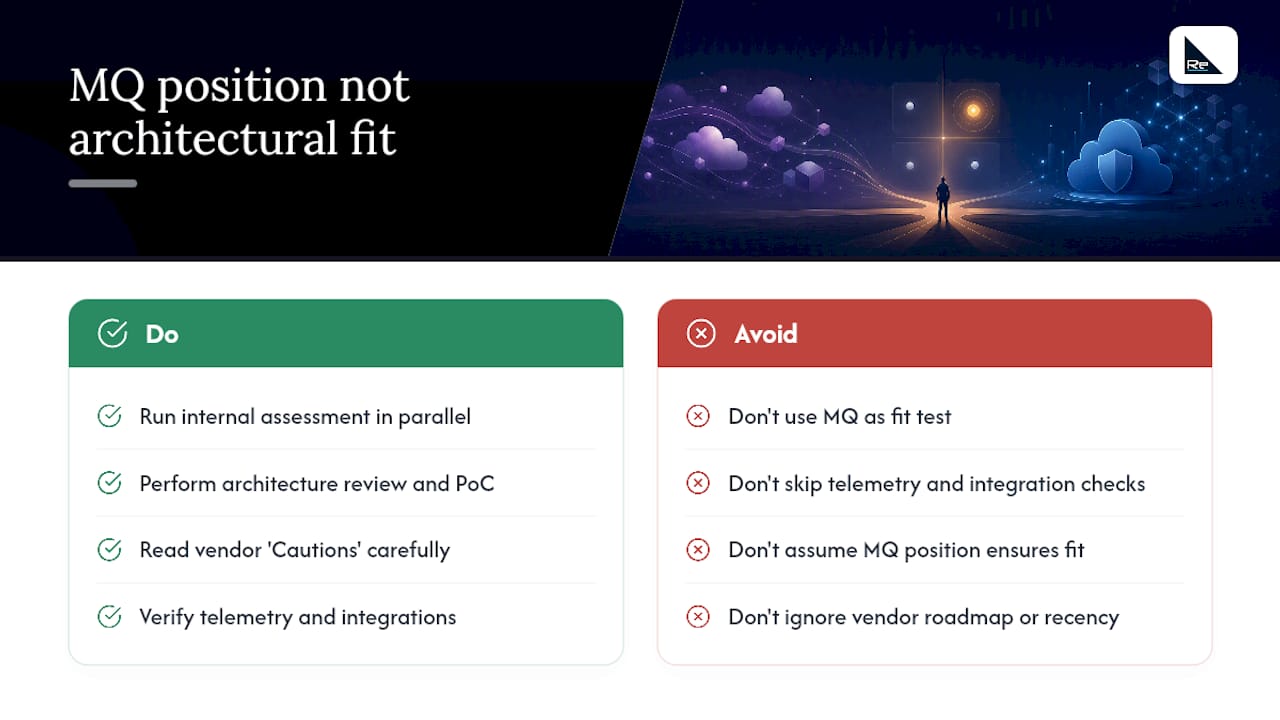
Three limitations matter most. First, publication lag: Gartner’s research calendar shows planned update windows throughout the year, and a quadrant published even a year ago may not reflect a vendor’s current roadmap, especially in fast-moving categories like CNAPP. Second, scope differences: the criteria Gartner uses for SSE differ substantially from CNAPP criteria, so a vendor’s strong CSPM heritage says nothing about its SSE maturity. Third, and most overlooked, the “Cautions” block under each vendor’s profile is where the real due diligence signal lives. Gartner’s strengths-and-cautions structure exists precisely because a Leader can still carry serious caveats, limited geographic support, weak integration with a specific SIEM, or immature API telemetry, that a glance at the quadrant position alone will never surface.
Gartner’s cloud security architecture guidance recommends integrating controls into a broader architectural blueprint using zero trust and defence-in-depth principles, rather than deploying isolated point solutions chosen purely on MQ position. This is where mismatches happen in practice: a vendor with excellent detection technology but poor CI/CD integration, or a platform that lacks the telemetry hooks your cloud provider requires for full visibility. Gartner’s own 2026 cybersecurity trends note growing use of personal generative AI accounts at work, with a meaningful share of employees feeding sensitive enterprise data into unmanaged tools, an exposure that many older MQ evaluations simply didn’t test for.
A vendor’s quadrant position tells you almost nothing about whether its product will slot into your existing stack without friction. That’s a question only your own architecture review, and a properly scoped PoC, can answer.
This is exactly why an internal cloud security assessment has to run in parallel with, not after, your MQ research.
Where to find Gartner reports and how to verify them
Gartner reports sit behind a subscription model for most clients, though individual reports are often available for single purchase, and many vendors licence and republish summary versions on their own sites, usually with a clear “Gartner names X a Leader” framing that omits the cautions section entirely. Treat vendor-republished excerpts as marketing, not primary research; go to the original report for the full strengths-and-cautions text whenever a purchase decision is on the table.
Beyond the Magic Quadrant itself, several sources help corroborate or extend what you read:
- Critical Capabilities reports, which score the same vendor set against specific use-case weightings rather than broad market position.
- Gartner Peer Insights, which aggregates verified customer reviews and is a useful counterweight to a vendor’s own reference customers.
- Independent test reports from security testing labs, which validate detection and performance claims outside Gartner’s own evidence-gathering process.
- Cloud Security Alliance guidance, which offers vendor-neutral frameworks for assessing cloud risk that complement rather than duplicate Gartner’s vendor-specific scoring.
- Insurance and compliance-sector commentary, such as analysis on how cloud security affects insurance and risk transfer, which is useful if your organisation needs to size residual risk after a vendor selection.
Whichever report you’re reading, check the cover page for the publication date and any note on the next planned update. A quadrant due for refresh within a few months is worth waiting for if your timeline allows it.
How Re-solution applies Magic Quadrant insight in real procurement
Re-solution doesn’t treat a Magic Quadrant position as a recommendation to hand a client. In a recent anonymised engagement for a multi-site education client, the starting point wasn’t a quadrant chart, it was an internal cloud security assessment that mapped existing gaps: inconsistent SaaS visibility across campuses, no centralised posture management across two cloud providers, and a legacy VPN struggling under hybrid staff and student access patterns. Only once that gap list existed did the relevant Magic Quadrants, SSE for the access problem, CSPM for the visibility gap, come into play as a shortlist filter.

The checklist Re-solution applies when translating MQ strengths and cautions into procurement criteria covers four areas:
| Criterion | What it checks | Why it matters |
|---|---|---|
| Integration matrix | Does the vendor natively support the client’s SIEM, identity provider and cloud platforms? | Avoids costly custom connector work post-purchase |
| Telemetry fit | Does the vendor expose the logging depth needed for the client’s SOC or MSSP? | Prevents blind spots discovered only after go-live |
| Support model | What are actual SLA response times, and is support regionally available? | Cautions blocks often flag support gaps Leaders can carry |
| Scaling and compliance | Can the platform scale to the client’s user count while meeting sector compliance needs? | Education and manufacturing clients often have specific regulatory constraints |
That integration matrix, built directly from the vendor’s published cautions block rather than its marketing deck, is what actually shapes the PoC design and the eventual managed service handover. Findings then feed into Re-solution’s broader managed IT services and NaaS engagements, where security monitoring and remedial roadmaps are built around the integration gaps the MQ research and internal assessment surfaced together, not around whichever vendor scored highest on a chart.
Why balanced use of the Magic Quadrant matters more than the quadrant itself
Too many procurement teams treat a Leader placement as the finish line, and that habit causes more failed rollouts than any single vendor’s product shortcomings. A Magic Quadrant is genuinely useful for narrowing a crowded market down to a defensible shortlist, but it was never designed to replace an architecture review, and Gartner says as much in its own methodology notes.
What gets underestimated is how much the “Cautions” section matters relative to quadrant position. Two vendors can sit side by side as Leaders in the same SSE quadrant, and one can have a caution flagging weak API telemetry for a specific cloud provider your organisation depends on. That single line can matter more to your rollout than either vendor’s overall execution score. Reading cautions closely, and pairing them against your own integration matrix, is the difference between a shortlist that saves time and one that just adds noise.
Re-solution’s advisory approach treats Gartner research as a filtering mechanism, not a verdict. Clients undertaking cloud security modernisation get more value from combining an honest internal assessment with a properly scoped PoC than from chasing whichever vendor topped this year’s chart. The quadrant narrows the field. The integration test decides the winner.
Get help interpreting Magic Quadrants and building your shortlist
Turning a Magic Quadrant chart into a working security stack is the part most guides skip, and it’s where projects actually stall or succeed. Re-solution runs infrastructure and security audits that translate MQ shortlists and Critical Capabilities scoring into a concrete integration plan, covering SIEM connectivity, cloud provider telemetry, and support model fit, before you commit budget to a PoC.
If you’re heading into a renewal cycle or evaluating SSE, CNAPP or CSPM vendors for the first time, the sensible next step is a structured network and security audit that benchmarks your current gaps against the criteria that actually matter for your environment, not a generic checklist. For organisations already leaning towards a managed model, Re-solution’s Network as a Service offering folds ongoing security monitoring and remediation directly into ongoing network management, so MQ-informed vendor selection doesn’t sit isolated from day-to-day operations. Get in touch to scope an audit or discuss how a PoC would run against your specific stack.
Sources
Start with Gartner’s own publication calendar to confirm currency, then move to the specific MQ relevant to your problem, followed by Critical Capabilities and Peer Insights for use-case and customer-experience validation.
When reading any vendor’s strengths and cautions block, weigh the cautions as heavily as the strengths. Gartner includes them precisely because quadrant position alone doesn’t capture operational risk.
- Gartner Magic Quadrant & Critical Capabilities
- Cloud security assessment fundamentals (Cloud Security Alliance blog)
FAQ
What is the Gartner Magic Quadrant?
It’s a visual research tool that positions technology vendors into four quadrants, Leaders, Visionaries, Niche Players and Challengers, based on their Ability to Execute and Completeness of Vision.
Which Magic Quadrant should I read for cloud security?
It depends on the problem: Security Service Edge for hybrid access, CNAPP for cloud-native workload protection, and CSPM for posture and misconfiguration management.
How often does Gartner update its Magic Quadrant reports?
Gartner refreshes most quadrants on a roughly annual cycle and lists planned update windows on its publication calendar, so always check the cover page date before relying on a report.
Should a Leader placement be the deciding factor in vendor selection?
No. Leader status reflects broad market execution and vision, not fit with your specific architecture, so it should narrow a shortlist rather than decide it.
How does Re-solution use Magic Quadrant research in procurement?
Re-solution pairs MQ shortlists and Critical Capabilities scoring with an internal cloud security assessment and a scoped proof of concept before recommending any vendor to a client.
What’s the difference between a cloud security assessment and a vendor evaluation?
A cloud security assessment is an internal, ongoing process of inventory and risk prioritisation, while a vendor evaluation, like a Magic Quadrant, compares external providers against market criteria.
Recommended
- Cloud Security Measures & Strategies | Re-Solution
- Cloud Security Consolidation with Cisco Umbrella | Re-Solution
- Top smart security solutions: safety and compliance 2026
- The Crucial Role of Zero Trust Security | Re-Solution