For UK organisations, the most effective way to establish enterprise IP connectivity is a Cisco-led SD-WAN or NaaS deployment built on three foundations: thorough site readiness, template-based Zero-Touch Provisioning (ZTP), and centralised policy with SASE integration. This approach replaces fragmented, hardware-centric connections with a managed overlay that routes traffic intelligently across internet, MPLS, and cellular underlays. Before any configuration begins, the recommended immediate next step is a structured site readiness assessment with Re-solution.
The three elements every deployment requires:
- Site readiness: confirmed power, rack space, internet underlay, and a complete network inventory (IP addressing plan, VLANs, routing, firewall rules, DNS, DHCP).
- Template-based ZTP: pre-built device templates and serial-number registration to automate branch onboarding at scale.
- Central policy and cloud gateway: application-aware routing, SASE integration, and direct cloud onramps to AWS, Azure, or GCP.
Key takeaways
A Cisco-led SD-WAN or NaaS deployment with ZTP, central policy, and SASE integration is the most reliable path to enterprise IP connectivity for UK organisations.
| Point | Details |
|---|---|
| Start with site readiness | Collect IP inventory, VLAN design, serial numbers, and underlay details before staging begins. |
| Use ZTP for branch scale | Bulk serial-number CSV registration supports up to 25 devices per cycle and removes on-site engineer dependency. |
| Match architecture to ownership model | NaaS suits cloud-first or resource-constrained teams; in-house SD-WAN suits organisations with certified Cisco engineers. |
| Validate against KPIs at cutover | Confirm low latency, low jitter, minimal packet loss, and timely failover before sign-off. |
| Re-solution as delivery partner | Re-solution provides site assessments, ZTP staging, managed NaaS/SD-WAN, and SASE integration for UK organisations. |
Table of Contents
- What must you prepare before connecting to an IP network?
- Which architecture fits your organisation: SD-WAN, NaaS, or hybrid?
- How does a phased deployment deliver enterprise IP connectivity?
- What design choices determine network performance and security?
- How do NaaS, managed service, and in-house models compare on cost?
- How do you validate that the IP connectivity deployment has succeeded?
- What pitfalls most often stall enterprise IP connectivity projects?
- How does Re-solution deliver enterprise IP connectivity for UK organisations?
- When should you choose NaaS or managed SD-WAN over in-house Cisco management?
- Re-solution can scope your IP connectivity project today
- Editorial perspective: the operational model decision matters more than the technology choice
- Sources
What must you prepare before connecting to an IP network?
Deployment delays almost always trace back to incomplete site data. The table below lists the inputs Re-solution requires before any project begins.
| Input category | Required detail |
|---|---|
| Power and physical space | Confirmed rack units, power feeds (redundant where required), and UPS capacity |
| Internet underlay | ISP circuit details, bandwidth, SLA tier, and failover circuit (if dual-ISP) |
| IP addressing plan | Subnet allocations, gateway IPs, and any existing IPAM documentation |
| VLAN design | VLAN IDs, names, and associated subnets for each traffic class |
| Routing | Static routes, BGP/OSPF parameters, and redistribution requirements |
| Firewall rules | Existing ACL/policy exports and inter-zone traffic requirements |
| DNS and DHCP | Server IPs, scope definitions, and any split-DNS requirements |
| Device inventory | Serial numbers, model numbers, and target site for each device |
| Site access | On-site contact, physical access windows, and third-party vendor details |
Enterprise SD-WAN onboarding uses bulk serial-number registration via CSV, supporting up to 25 devices per registration cycle. Collecting serial numbers before staging begins is the single action that most reliably shortens branch activation time.
Pro Tip: Build a shared CSV template at project kick-off with columns for serial number, device model, target site, and assigned device template. Distribute it to each site contact and set a hard deadline two weeks before staging. Incomplete rows at that deadline are the most common cause of ZTP onboarding failures.
Which architecture fits your organisation: SD-WAN, NaaS, or hybrid?
The choice between SD-WAN, NaaS, and a hybrid model depends on ownership preference, cloud maturity, and in-house Cisco capability. Cisco Catalyst SD-WAN provides application-aware routing and Cloud OnRamp features that optimise SaaS and multi-cloud connectivity across internet, MPLS, and cellular underlays.
| Criteria | SD-WAN (self-managed) | NaaS (subscription) | Hybrid |
|---|---|---|---|
| Speed to deploy | Medium | Fast | Medium |
| Cost model | CapEx + OpEx | OpEx only | Mixed |
| Cloud integration | Manual onramp config | Bundled gateways | Partial |
| Security model | Customer-managed | SASE-integrated | Shared |
| Management responsibility | In-house team | Provider-managed | Split |
NaaS shifts network ownership to a cloud consumption model, using SDN and NFV to deliver on-demand, scalable services that reduce CapEx and increase agility for cloud-first organisations. Cisco positions NaaS as a model that replaces hardware-centric VPNs and MPLS with virtualised, subscription-based services tied to SASE architecture.
Typical use cases by model:
- SD-WAN (self-managed): multi-branch retail or manufacturing with a strong in-house Cisco team needing granular policy control.
- NaaS: cloud-first organisations, shared workspaces, and hospitality groups prioritising predictable OpEx and rapid site activation.
- Hybrid: organisations mid-migration from MPLS, retaining private links for sensitive workloads while moving SaaS traffic to internet breakout.
For background on Meraki SD-WAN approaches and SDN principles, Re-solution’s technology primer covers the key architectural differences. Multi-cloud connectivity patterns and operational models are explored further in this enterprise multi-cloud guide.
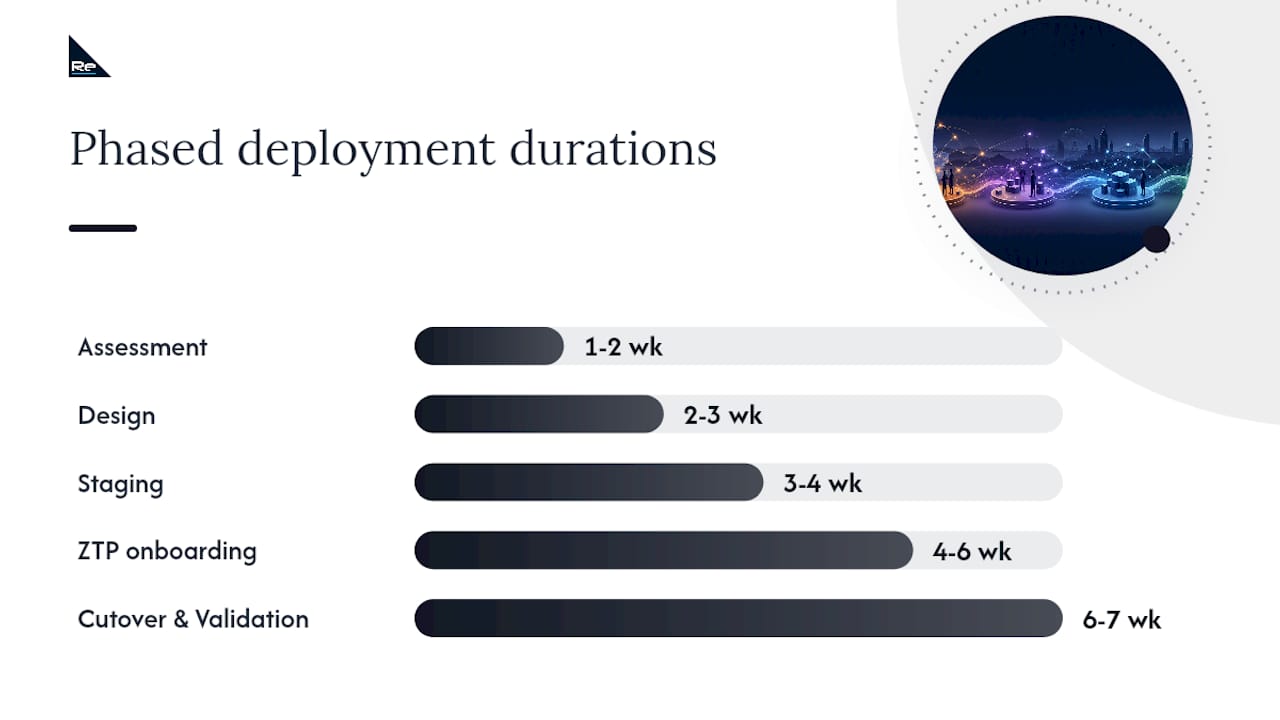
How does a phased deployment deliver enterprise IP connectivity?
A structured, phased approach keeps scope, cost, and risk under control across sites of any scale.
- Assessment (weeks 1–2): Re-solution conducts site surveys, collects the network inventory table above, and validates underlay circuits. Customer responsibility: provide site access and complete the data inputs.
- Design (weeks 2–3): Re-solution produces a high-level design covering IP addressing, VLAN structure, routing policy, and security zoning. Customer sign-off required before staging begins.
- Staging and template creation (weeks 3–4): Device templates are built and tested in a lab environment. ZTP bulk registration is completed using the serial-number CSV. The SD-WAN management centre automates VPN tunnel creation, DVTI/SVTI assignment, and overlay BGP parameters for hub-and-spoke topologies.
- ZTP onboarding (weeks 4–6): Branch devices connect to the internet, pull their configuration automatically, and register against the management platform. No on-site engineer is required for standard branch activation.
- Cutover (week 6–7): Traffic is migrated from legacy circuits to the SD-WAN overlay. Cutover windows are agreed with the customer and ISP. Fallback to legacy circuits remains available for 48 hours post-cutover.
- Validation (week 7): Acceptance tests are run against agreed KPIs (see the testing section below). Re-solution and the customer sign off each site.
- Handover (week 8): Documentation, runbooks, monitoring alerts, and operational contacts are transferred. Managed service or NaaS support begins.
Acceptance criteria at cutover: all primary tunnels established, application-aware routing policies active, failover tested and within threshold, and DNS/DHCP serving all VLANs correctly.
What design choices determine network performance and security?
Application-aware routing and SaaS optimisation
Application-aware routing steers Microsoft 365, voice, and other business-critical SaaS traffic over the best available path automatically. Traffic destined for known SaaS endpoints uses direct internet breakout at the branch; private MPLS or dedicated circuits carry latency-sensitive or regulated data.

Segmentation: VRF, VLAN, and inter-VRF route leaking
Multi-VRF deployments isolate traffic for IoT devices, contractors, and employee networks within the same physical infrastructure. Each VRF requires dedicated VLANs, loopback interfaces, and routing instances. Inter-VRF route leaking, controlled via firewall policy or explicit route import/export, allows shared services such as DNS and DHCP to remain accessible across segments without collapsing the security boundary. ACI Multi-Site deployments add a further layer: they require pre-provisioned Inter-Site Networks with OSPF and MP-BGP EVPN peerings, dedicated TEP pools, and specific spine/loopback configuration to enable intersite policy and data-plane connectivity.
Security mapping: SASE, Zero Trust, and device onboarding
Cisco’s SASE architecture unifies SD-WAN and cloud security into a single policy framework, combining Cisco Umbrella (DNS-layer security and SWG), Cisco AnyConnect (remote access VPN and ZTNA), and Cisco Duo (MFA and Zero Trust device verification) with the SD-WAN overlay. Device onboarding policies enforce posture checks before granting network access, ensuring unmanaged or non-compliant endpoints cannot reach sensitive segments.
Re-solution’s SASE implementation guidance maps these components to UK enterprise security requirements, including data sovereignty considerations under UK GDPR. For organisations handling regulated data, cloud gateway egress must be confirmed as UK-resident before production traffic is migrated.
How do NaaS, managed service, and in-house models compare on cost?
Primary cost drivers across all models:
- Hardware: edge routers, switches, and wireless access points (CapEx under self-managed; bundled under NaaS).
- Licences: Cisco DNA, SD-WAN, Umbrella, Duo, and AnyConnect subscriptions.
- Underlay circuits: ISP contracts, bandwidth tiers, and failover links.
- Managed support: NOC monitoring, incident response, and change management.
- Professional services: design, staging, deployment, and acceptance testing.
- Cloud gateway egress: data transfer costs for AWS, Azure, or GCP onramps.
Under a NaaS subscription, hardware, licences, and managed support are bundled into a single monthly per-site fee, converting the majority of spend to predictable OpEx. A Re-solution managed service contract adds NOC coverage and SLA-backed response times on top of a customer-owned Cisco estate. In-house management retains full control but requires certified Cisco engineers and ongoing licence management.
Procurement tips: contract terms of 36 months typically reduce per-site unit costs compared to 12-month terms. A pilot-to-rollout payment structure, where the first two or three sites are invoiced separately before full programme commitment, reduces financial risk for large multi-site programmes. SLAs and acceptance test criteria should be written into the contract schedule, not left as verbal agreements.
How do you validate that the IP connectivity deployment has succeeded?
Run the following tests at cutover for each site:
- Confirm primary and secondary tunnel establishment and verify overlay BGP adjacencies.
- Test application-aware routing by generating Microsoft 365 and voice traffic and confirming correct path selection in the SD-WAN dashboard.
- Simulate underlay failure on the primary circuit and confirm failover completes within the agreed threshold.
- Verify all VLAN interfaces are up and that DHCP scopes are serving addresses on each segment.
- Confirm DNS resolution for internal and external names from each VLAN.
- Test inter-VRF access controls: confirm IoT and contractor segments cannot reach employee resources without traversing the firewall.
- Validate Cisco Umbrella DNS-layer policy is active and blocking test threat categories.
- Confirm Cisco Duo MFA is enforced for remote access via AnyConnect.
| KPI | Threshold |
|---|---|
| WAN latency (site to data centre) | Low latency |
| VoIP latency (end-to-end) | Acceptable latency |
| Jitter | Low jitter |
| Packet loss | Below 1% |
| Failover time (primary to secondary underlay) | Fast failover |
Handover checklist: as-built network diagrams, device template backups, runbook covering common fault scenarios, monitoring alert definitions, escalation contacts for Re-solution NOC and ISP, and a schedule for the first post-deployment review.
What pitfalls most often stall enterprise IP connectivity projects?
- Incorrect IP inventory: subnets documented in spreadsheets rarely match what is actually configured. Pre-flight validation using a network audit tool against the live estate catches conflicts before staging.
- Insufficient power or rack space: sites approved in a desktop survey frequently fail physical inspection. Confirm rack units and power feeds on-site before ordering hardware.
- Missing ISP details: circuit IDs, handoff IP addresses, and BGP ASNs are often held by a third-party ISP account manager. Collect these at project kick-off, not during cutover week.
- Incompatible legacy kit: older switches without 802.1Q trunking or routers running end-of-support IOS versions block ZTP and template-based onboarding. Identify these during the assessment phase and budget for replacement.
- Complex VRF misconfiguration: multi-VRF deployments with DMVPN require unique tunnel keys per VRF and carefully controlled route import/export. Test inter-VRF leaking in the staging lab before any live cutover.
- Data sovereignty gaps: confirm that cloud gateway egress and any managed NOC data handling comply with UK GDPR before production go-live. This is a design decision, not a post-deployment fix.
Staged rollouts, starting with two or three pilot sites, surface the majority of these issues before the full programme is committed. A documented fallback plan, retaining legacy circuit access for 48 hours post-cutover, limits the blast radius of any unforeseen failure.
How does Re-solution deliver enterprise IP connectivity for UK organisations?
Re-solution is a Cisco partner with over 35 years of experience delivering network infrastructure across education, manufacturing, logistics, hospitality, shared workspaces, and property development in the UK. The service scope covers every phase of a connect-to-IP project:
- Site readiness assessments and network audits to validate physical and logical prerequisites.
- Pilot and staging environments for template development and ZTP testing.
- SD-WAN and NaaS delivery, including hub-and-spoke topology design, overlay routing, and cloud gateway configuration.
- SASE integration covering Cisco Umbrella, AnyConnect, and Duo deployment.
- Managed operations with NOC monitoring, SLA-backed incident response, and change management.
- Periodic audits and compliance reviews aligned to UK regulatory requirements.
Pro Tip: Request a documented high-level design as a deliverable from the assessment phase, not just a verbal recommendation. A written design gives procurement teams a concrete scope to contract against and prevents scope creep during delivery.
When should you choose NaaS or managed SD-WAN over in-house Cisco management?
The case for NaaS or a managed SD-WAN service is strongest when an organisation lacks certified Cisco engineers in-house, needs to activate multiple sites quickly, or requires predictable monthly costs for budget planning. Rapid cloud onramps, bundled security licences, and NOC coverage are difficult to replicate with a small internal team, particularly when the network spans more than five or six sites.
In-house management makes sense when a strong Cisco team already exists, when legacy integrations require close, hands-on control, or when the organisation’s security policy prohibits third-party access to network management planes. The decision is rarely binary: many UK organisations run a hybrid model, retaining in-house management for the data centre core while outsourcing branch SD-WAN to a managed provider.
A practical decision checklist:
- Cisco-certified engineers on staff? If not, NaaS or managed service is lower risk.
- More than five sites to activate within six months? ZTP at scale benefits from a provider’s staging infrastructure.
- Predictable OpEx required for board approval? NaaS subscription pricing simplifies the business case.
- Regulated data requiring UK-resident processing? Confirm provider NOC and cloud gateway locations before contracting.
- Legacy MPLS circuits with long notice periods? A hybrid model preserves existing contracts while migrating SaaS traffic to SD-WAN.
Re-solution can scope your IP connectivity project today
Re-solution delivers managed NaaS and SD-WAN services for UK organisations that need enterprise IP connectivity without the overhead of building and maintaining a Cisco practice in-house. The starting point is a site readiness assessment: a structured engagement that produces a validated network inventory, a high-level design, and a costed proposal covering hardware, licences, underlay, and managed support.

Pilot projects are available for organisations that want to validate the model across two or three sites before committing to a full programme. Bespoke commercial structures, including NaaS subscription, managed service, and hybrid models, are scoped to match your procurement requirements. Contact Re-solution to request an assessment or a NaaS discovery call via the contact page, or review the full IT infrastructure challenges guide to scope your project requirements first.
Editorial perspective: the operational model decision matters more than the technology choice
Most IT directors spend the majority of their evaluation time comparing Cisco product features. The more consequential decision is who manages the network once it is live.
Cisco’s SD-WAN and NaaS toolset is mature. The gap between a well-run managed deployment and a poorly resourced in-house one is not a feature gap; it is an operational one. Organisations that underestimate the ongoing demand of policy management, licence renewals, and incident response consistently find that the in-house model costs more than the NaaS alternative once engineer time is fully accounted for.
The organisations that get the most value from a managed or NaaS model are not necessarily the smallest. Some of the most complex multi-site deployments benefit from managed operations precisely because the complexity is high and the tolerance for downtime is low. Conversely, a well-staffed Cisco team at a single large campus can absolutely justify in-house management, provided the team has the bandwidth to absorb change requests alongside BAU.
The practical signal to watch: if your Cisco-certified engineers are routinely pulled onto other infrastructure projects, the network will be under-managed. That is the moment to reassess the operational model, not after the first major outage.
Sources
- Cisco Catalyst SD‑WAN (Software‑Defined WAN) – Cisco
- Network‑as‑a‑Service (NaaS): The Future of Agile, Cloud‑First Networking
Recommended
- IP connect for UK IT teams: what to choose
- Cloud networking in hospitality: a guide for IT leaders
- Network Infrastructure Planning Simplified | Re-Solution
- Network Infrastructure Planning Simplified | Re-Solution